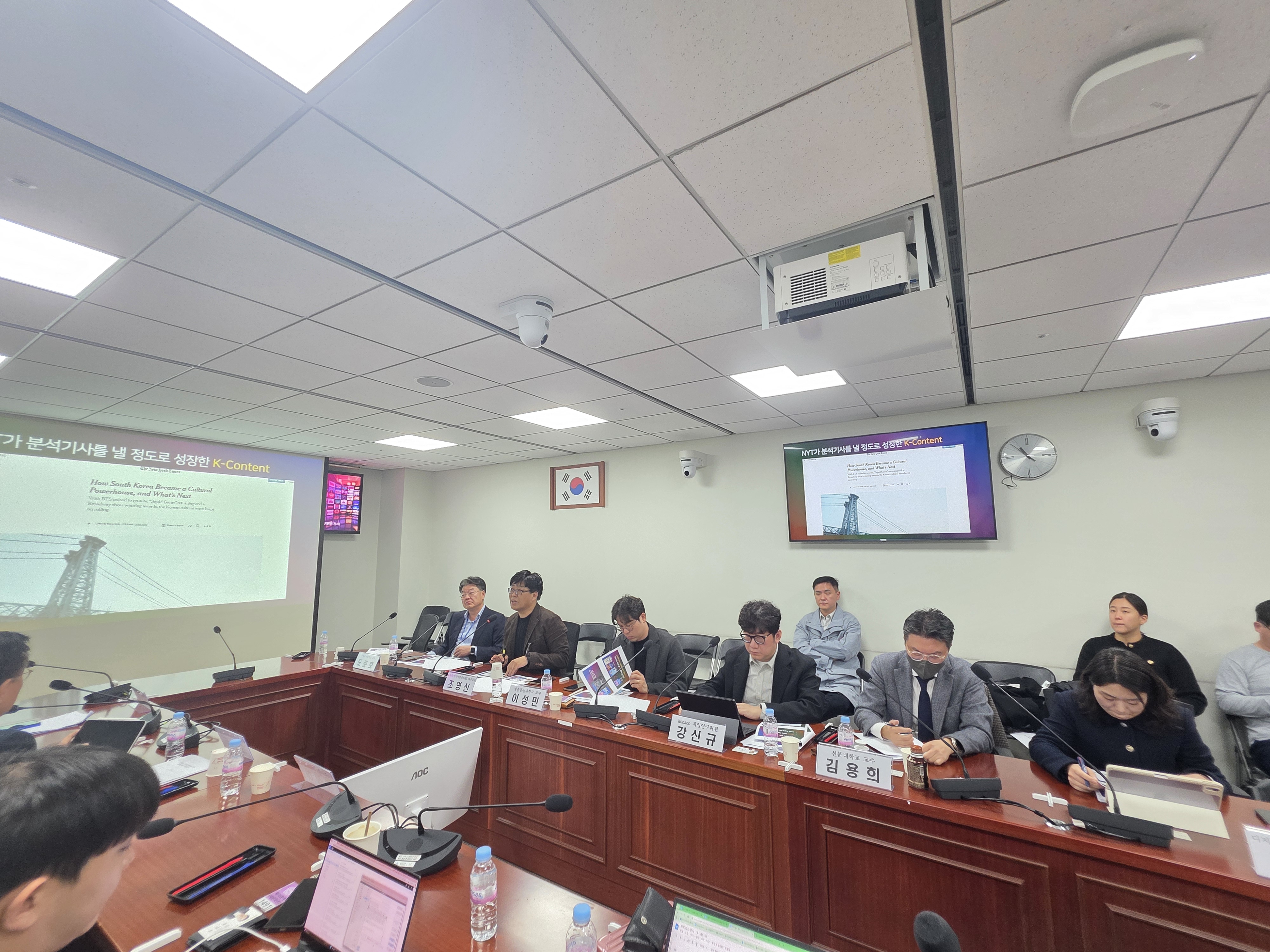
2025년 11월 11일, 국회 미디어·통신 포럼이 주최한 “케이콘텐츠 지식재산 주권 확보와 국내 산업 활성화를 위한 정책 방향” 토론회에 토론자로 참여했습니다.
진짜 위기: 제작 역량이 아니라 수익모델
이성민 교수의 발제는 케이콘텐츠 산업이 마주한 구조적 문제를 정확하게 진단했습니다. 이것이 “제작 역량의 위기가 아니라 수익모델의 위기”라는 핵심 주장에 전적으로 동의합니다. 토론에서는 경영경제학의 분석 틀을 적용해, 지식재산의 소유와 활용 사이의 간극에 초점을 맞춰 논의를 한층 깊게 이어 갔습니다.
1. 위기의 본질: 파생수요의 붕괴와 수요독점 시장 구조
방송산업 데이터는 냉정합니다. 2024년 매출은 0.9% 감소했고, 영업이익은 26.7% 급감했습니다. 더 심각한 것은 광고매출입니다. 2020년 2조 7천억 원에서 2024년 2조 3천억 원으로, 4,200억 원이 사라졌습니다. 이는 콘텐츠에 대한 파생수요가 구조적으로 무너지고 있음을 뜻합니다.
국내 온라인 동영상 서비스 상황은 또 다른 측면을 드러냅니다. 2024년 온라인 동영상 서비스 이용률은 89.3%에 이르러 시장 포화를 보여 주지만, 유료 서비스의 월평균 지출은 오히려 12,005원에서 10,500원으로 줄었습니다.
2. 지식재산의 실물옵션 가치와 활용의 간극
콘텐츠 지식재산은 단순한 자산이 아니라, 불확실한 미래 가치 흐름을 창출할 수 있는 권리입니다. 오징어 게임 사례가 이를 완벽하게 보여 줍니다. 넷플릭스는 옵션의 시간 가치와 변동성 프리미엄을 체계적으로 실현하고 있습니다.
중요한 오해 하나를 바로잡아야 합니다. 현재 글로벌 온라인 동영상 서비스 계약에서 지식재산을 완전히 포기하는 경우는 약 15%에 불과합니다. 나머지 85%는 이미 지식재산 투자와 수익 배분을 공유하는 구조입니다. 그렇다면 진짜 문제는 무엇일까요. 지식재산의 소유 자체가 아니라, 확보한 지식재산을 활용하지 못한다는 점입니다.
3. 진짜 위기: 물량 감소와 생태계 붕괴
제작 편수는 2022년 141편에서 2024년 107편으로 줄었습니다. 글로벌 온라인 동영상 서비스가 효율화 국면으로 전환하면서 검증된 프로젝트에만 투자하고, 그 결과 진입 장벽이 높아지고 있습니다.
4. 글로벌 가치사슬과 산업 재편
한국 콘텐츠 산업은 글로벌 가치사슬에 완전히 편입되었습니다. 이는 되돌릴 수 없는 구조적 변화입니다. 한국은 기획과 제작에서 세계적 경쟁력을 갖추고 있지만, 대규모 자금과 글로벌 유통·마케팅의 대부분, 그리고 2차 활용의 실제 집행은 주로 글로벌 플랫폼이 주도합니다.
5. 정책의 역할: 지식재산 활용 생태계 구축
첫째, 한국형 제작위원회를 육성해야 합니다. 귀멸의 칼날 모델처럼, 강한 내수 시장에서 성공을 입증한 뒤 글로벌로 확장하는 전략이 필요합니다.
둘째, 케이 지식재산 사업화 전담 기관을 설립해야 합니다. 이 기관은 기존 사업을 통합하는 동시에, 글로벌 브랜드와의 실질적인 매칭에 집중해야 합니다.
셋째, 국내 생태계의 자생력을 강화해야 합니다. 내수 수요의 확보가 협상력의 핵심입니다.
넷째, 선별적 재정 지원을 초기 마중물로 검토해야 합니다. 케이 지식재산 활용 펀드가 초기 촉매 역할을 할 수 있습니다.
맺으며
목표는 글로벌 온라인 동영상 서비스를 배제하는 것이 아니라, 국내 플랫폼에 협상력을 갖추게 하는 것입니다. 귀멸의 칼날이 일본 시장에서 먼저 성공을 입증하고 이를 지렛대 삼아 넷플릭스와 유리한 조건으로 계약했듯이, 한국도 첫 번째 창구에서 강한 국내 플랫폼으로 성공을 먼저 입증한 뒤 글로벌 온라인 동영상 서비스와 대등한 동반자로 협력하는 구조를 만들어야 합니다.
On November 11th, 2025, I participated as a discussant at the National Assembly forum titled “Policy Directions for Securing K-Content IP Sovereignty and Revitalizing the Domestic Industry,” hosted by the National Assembly’s Media & Communications Forum.
The Real Crisis: Not Production Capability, But Revenue Models
Professor Lee Seong-min’s presentation accurately diagnosed the structural problems facing the K-content industry. I fully agree with the core argument that this is “a crisis of revenue models, not production capability.” In my discussion, I applied a business economics framework to deepen the analysis, focusing on the gap between IP ownership and IP utilization.
1. The Essence of the Crisis: Collapse of Derived Demand and Monopsony Market Structure
The broadcasting industry data is stark. In 2024, revenue declined by 0.9%, and operating profit plummeted by 26.7%. More seriously, advertising revenue decreased from 2.7 trillion won in 2020 to 2.3 trillion won in 2024, a loss of 420 billion won. This represents a structural collapse of derived demand for content.
The domestic OTT situation reveals another dimension. OTT usage reached 89.3% in 2024, indicating market saturation, while average monthly spending on paid OTT actually decreased from 12,005 won to 10,500 won.
2. IP’s Real Options Value and the Utilization Gap
Content IP isn’t merely an asset but a right to create uncertain future value streams. The Squid Game case demonstrates this perfectly. Netflix systematically realizes option time value and volatility premium.
An important misconception must be corrected. Currently, only about 15% of global OTT deals involve complete IP abandonment. The remaining 85% already involve shared IP investment and revenue distribution. So what’s the real problem? Not IP ownership itself, but the inability to utilize secured IP.
3. The Real Crisis: Volume Decrease and Ecosystem Collapse
Production dropped from 141 titles in 2022 to 107 in 2024. As global OTTs shift to efficiency phases, they invest only in proven projects, raising entry barriers.
4. Global Value Chain and Industrial Restructuring
The Korean content industry has fully integrated into the global value chain. This is an irreversible structural change. Korea has world-class competitiveness in planning and production, but substantial funding, most global distribution and marketing, and actual execution of secondary utilization are primarily led by global platforms.
5. Policy Roles: Building IP Utilization Ecosystems
First, foster Korean-style production committees. Like the Demon Slayer model, strategies that prove success in strong domestic markets before global expansion are needed.
Second, establish a K-IP Commercialization Agency. This agency should integrate existing programs while focusing on actual matching with global brands.
Third, strengthen domestic ecosystem self-sustainability. Securing domestic demand is the core of negotiation power.
Fourth, consider selective financial support as an initial catalyst. A K-IP Utilization Fund can serve as the initial catalyst.
Conclusion
The goal is not to exclude global OTTs but to equip domestic platforms with negotiation power. Just as Demon Slayer first proved success in the Japanese market and leveraged that to contract with Netflix on favorable terms, Korea should create a structure where it first proves success through strong domestic platforms in the first window, then cooperates with global OTTs as equal partners.