스마트폰 어플리케이션 서비스의 불만족이 고객 행동에 미치는 영향에 관한 연구Smartphone Application Service Dissatisfaction and Customer Behavior
Original title: 스마트폰 어플리케이션 서비스의 불만족이 고객 행동에 미치는 영향에 관한 연구
번역 제목은 이 사이트의 편집 번역입니다. 서지와 인용에는 원문 제목을 사용합니다.Translated titles are editorial translations for this site. Bibliographic records and citations retain the original title.
저자 표시: Author notes: 굵은 글씨: 김용희Bold: Yonghee Kim 교신저자Corresponding author
품질경영학회지, 40(3), 359–371색인: Indexed in: KCI
요약Summary
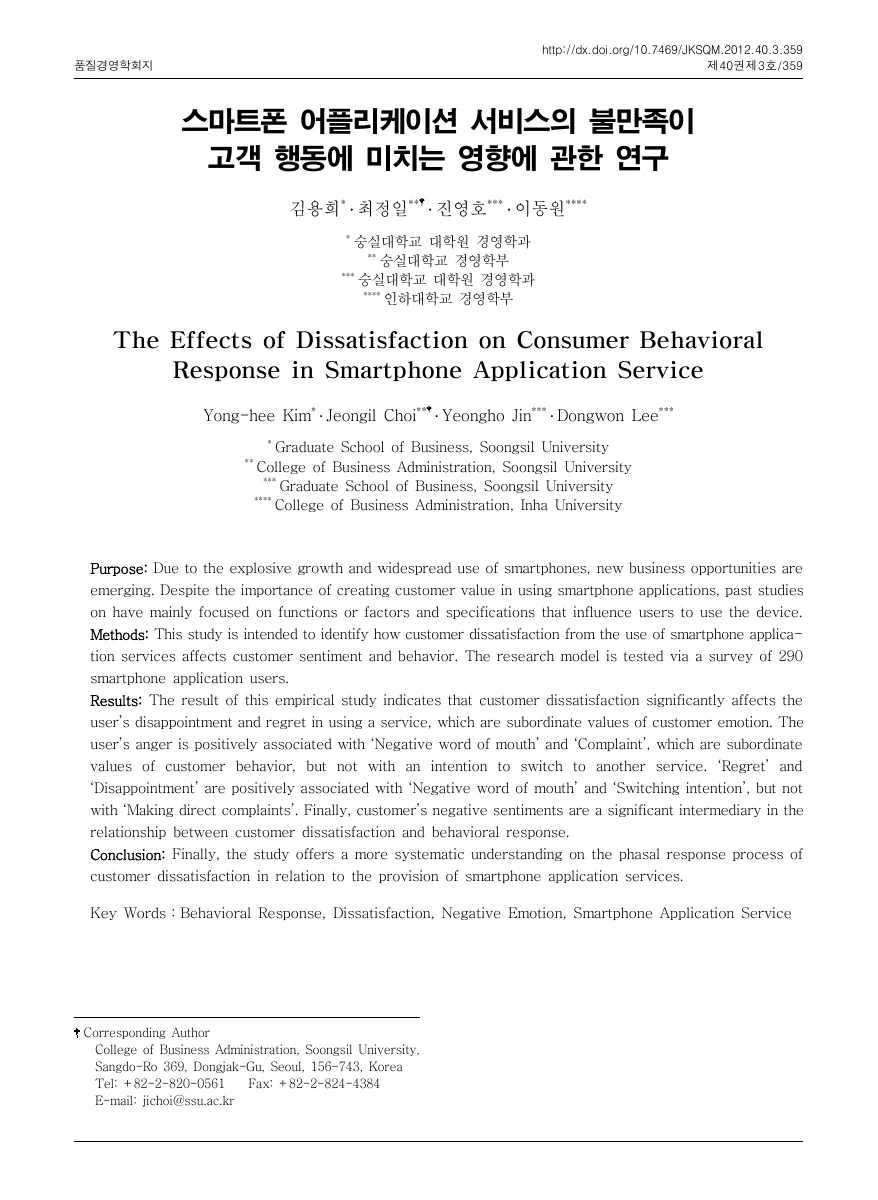
스마트폰 앱 이용자 설문(본문 분석 280명, 초록에는 290명 표기)으로 불만족이 감정과 행동 반응으로 이어지는 경로를 분석했다. 분노는 부정적 구전·불평과, 후회와 실망은 부정적 구전·전환의도와 각각 다른 관계를 보였다.
A survey of smartphone-app users (280 in the main-text analysis; 290 in the abstract) examines paths from dissatisfaction to emotions and behavioral responses. Anger relates to negative word of mouth and complaints, while regret and disappointment relate to negative word of mouth and switching intention.
한눈에 보기At a glance
- 표본 크기Sample size
- N = 280
- 방법Methods
- Survey Research
- Path Analysis
- Mediation Analysis
원문을 바탕으로 연구의 논리와 결과를 풀어쓴 해설입니다. 수치는 표시한 표와 쪽을 기준으로 읽습니다. 아래 표는 핵심 항목을 웹에서 읽도록 재구성했고, 원문 표·그림이 있는 페이지를 함께 제공합니다.This reading guide explains the paper’s reasoning and findings in new wording. Tables below re-present selected source results for web reading, alongside images of the relevant original pages.
연구 질문과 배경Question and context
앱 서비스에 불만족한 고객은 왜 어떤 때에는 항의하고 어떤 때에는 조용히 떠나려 할까. 이 연구는 불만족을 하나의 행동 반응으로 곧바로 연결하는 대신 후회·분노·실망이라는 감정을 구분한다. 같은 불쾌한 경험이라도 부정적 구전, 서비스 전환의도, 판매처에 대한 불평으로 이어지는 경로가 다를 수 있다는 질문이다. 서비스 실패를 이해하려면 고객이 느끼는 감정과 외부로 드러난 반응을 분리해 봐야 한다는 문제의식이 배경이다.
Why do some dissatisfied app users complain while others intend to leave without a direct complaint? The study separates regret, anger and disappointment rather than mapping dissatisfaction onto one generic reaction. It asks whether these emotions have different relationships with negative word of mouth, switching intention and complaints. Its starting point is that understanding service failure requires distinguishing an internal emotional response from an observable or intended customer response.
PDF 파일 1, 6, 10, 11쪽PDF pages 1, 6, 10, 11
자료와 변수Data and variables
서울의 대학생·대학원생·직장인 등을 대상으로 약3주 동안 조사했다. 본문은304부에서 부실·결측 등24부를 제외한280부를 분석했다고 쓰고, 인구통계표도 남193명·여87명으로 합계280명이다. 반면 초록은290명으로 기재되어 충돌한다. 이 해설의 자료 설명은 본문과 표의280명 기준이다. 불만족, 후회·분노·실망, 부정적 구전·전환의도·불평을 설문으로 측정했으며 실제 이탈 로그나 민원 처리 건수를 추적한 자료는 아니다.
The survey covers Seoul-based students and workers over roughly three weeks. The body states 304 questionnaires minus 24 exclusions, leaving 280; the demographic table also totals 280. The abstract instead says 290. This account follows the body and table while preserving the conflict. Dissatisfaction, emotions and behavioural responses are questionnaire measures, not tracked churn events, complaint records or longitudinal observations.
PDF 파일 1, 6쪽PDF pages 1, 6
방법을 쉽게 읽기How the method works
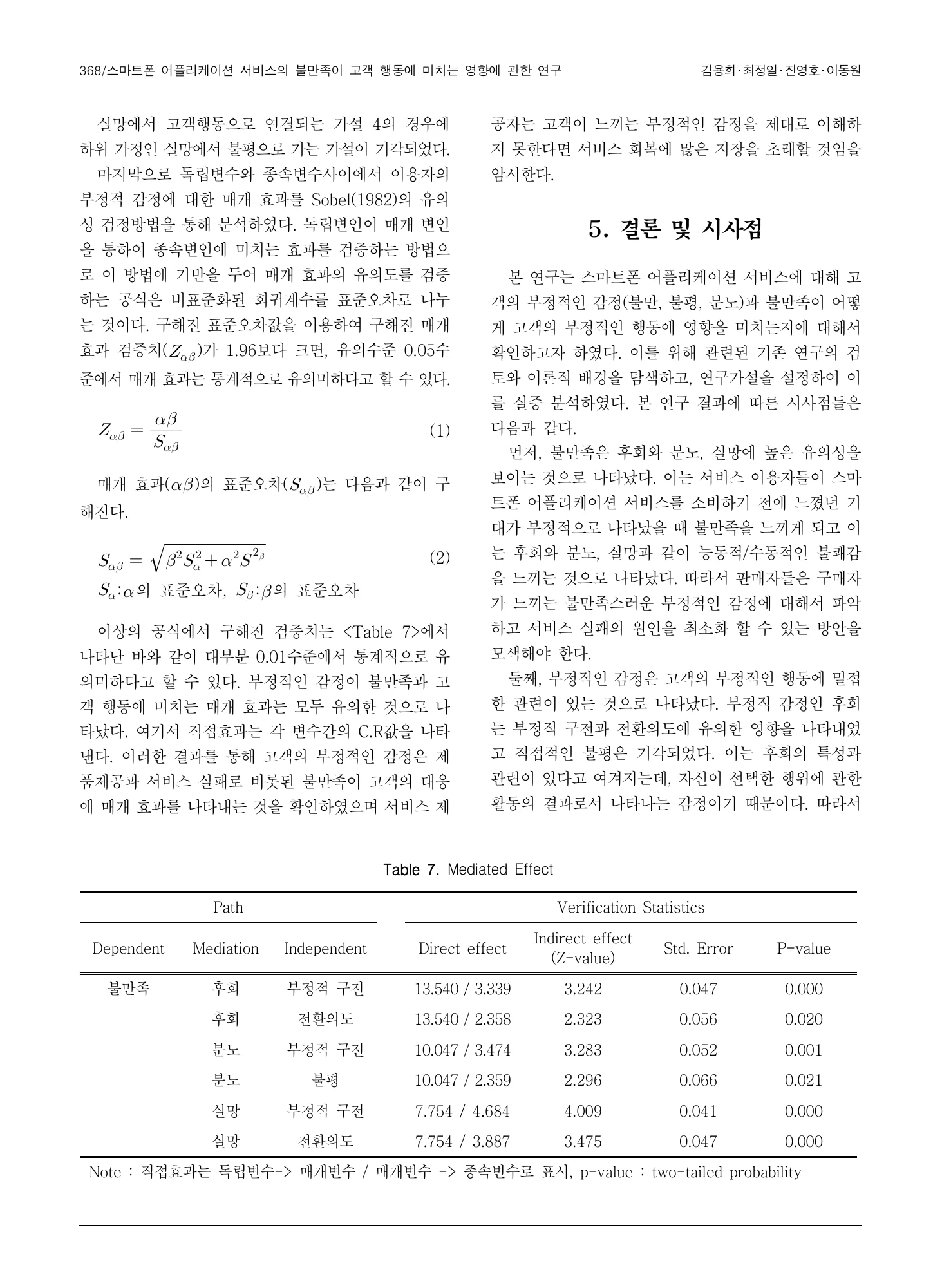
연구는 문항들이 감정·행동 개념을 구분해 측정하는지 요인분석으로 점검하고 구조모형의 경로를 추정했다. 이어 Sobel 검정으로 불만족→감정→행동의 간접 경로를 검토한다. 쉬운 말로는 불만족의 크기만 보는 대신 그 불만족이 어떤 감정의 형태로 표현되는지를 경유해 반응을 설명하는 방식이다. 다만 한 시점의 설문에서 간접 경로가 유의하다고 해서 시간적으로 감정이 먼저 생겨 실제 행동을 일으켰다는 사실까지 확인되는 것은 아니다.
Factor analyses assess the emotional and behavioural constructs before the path model is estimated. Sobel tests examine indirect paths through emotions. In accessible terms, the model asks not only how dissatisfied a person is but also which emotion expresses that dissatisfaction. Statistical mediation in a cross-sectional survey does not establish that the emotion occurred first and subsequently caused a recorded behavioural event.
PDF 파일 6, 9, 10쪽PDF pages 6, 9, 10
주요 결과와 수치의 의미Findings and their meaning
표6에서 후회→부정적 구전은0.210(p=.001), 후회→전환의도는0.167(p=.018)이지만 후회→불평은0.010(p=.895)로 유의하지 않다. 분노→불평은0.226(p=.018)이고 분노→전환의도는0.108(p=.201)로 유의하지 않다. 실망→전환의도는0.306으로 유의한 반면 실망→불평은0.133(p=.125)이다. 감정마다 반응의 연결이 다르다는 것이 핵심이다. 계수는 퍼센트나 실제 이탈률이 아니며, 원문의 p=.000 표시는 정확한0이 아니라 반올림된 작은 값으로 읽는다.
Table 6 reports regret→negative word of mouth at 0.210 (p=.001) and regret→switching at 0.167 (p=.018), but not regret→complaint. Anger→complaint is supported at 0.226 (p=.018), while anger→switching is not. Disappointment relates to switching but not direct complaints. These different patterns are the main finding. Coefficients are not percentages or observed churn rates; printed p=.000 values are rounded, not literally zero probabilities.
PDF 파일 9, 10쪽PDF pages 9, 10
핵심 결과를 표로 읽기Read the key results in tables
| 경로Path | 계수Coefficient | p값·원문 판정p value and reported decision |
|---|---|---|
| 후회→부정적 구전Regret→negative WOM | 0.210 | .001 · 채택Supported |
| 후회→전환의도Regret→switching | 0.167 | .018 · 채택Supported |
| 후회→불평Regret→complaint | 0.010 | .895 · 기각Not supported |
| 분노→전환의도Anger→switching | 0.108 | .201 · 기각Not supported |
| 분노→불평Anger→complaint | 0.226 | .018 · 채택Supported |
| 실망→전환의도Disappointment→switching | 0.306 | <.001 · 채택Supported |
| 실망→불평Disappointment→complaint | 0.133 | .125 · 기각Not supported |
표6 선별 전사. p=.000은 <.001로 표시했다. 표본은 초록290명과 달리 본문·표에서280명이며 원자료 대조가 필요하다.Selected Table 6 paths; printed p=.000 is shown as <.001. The body/table sample is 280, conflicting with 290 in the abstract.
원문 Table 6, PDF9쪽; 표본 근거 PDF1·6쪽Source Table 6, PDF p.9; sample evidence pp.1 and 6 · PDF 파일 1, 6, 9쪽PDF pages 1, 6, 9
원문의 핵심 표·그래프Key tables & figures in the source
표·그림이 수록된 원문 페이지입니다. 이미지를 누르면 확대할 수 있습니다.Original pages containing the selected tables or figures. Select an image to enlarge it.
표6 감정과 고객행동의 경로분석Table 6: emotions and behavioural responses
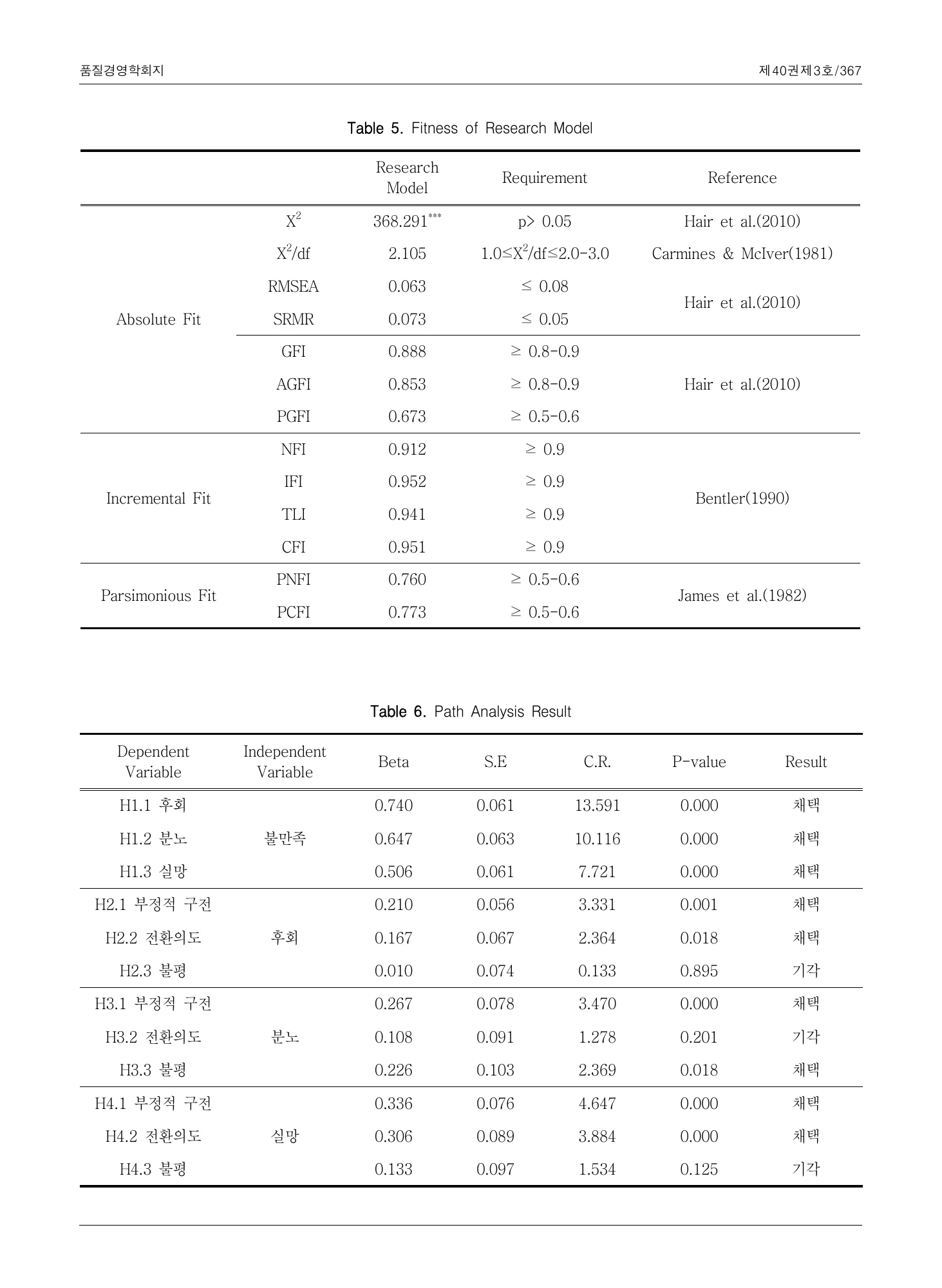
표7 간접 경로 검정Table 7: mediation tests
시사점Implications
원문은 기업이 접수된 불평만으로 서비스 실패의 규모를 파악하면 고객의 부정적 경험을 놓칠 수 있다고 해석한다. 직접 항의하지 않는 후회·실망 고객도 다른 곳에 부정적 의견을 말하거나 전환을 생각할 수 있기 때문이다. 해설상으로는 고객 회복 전략을 하나의 불만 점수로 통일하기보다 감정과 반응 채널을 함께 살피는 접근이다. 고객 불평을 쉽게 수용하는 창구와 지속적인 서비스 개선을 제안하지만, 특정 회복 프로그램의 성과를 실험해 비교한 것은 아니다.
The authors suggest that received complaints alone can underestimate service failure: regretful or disappointed customers may spread negative views or consider switching without confronting the provider. An interpretive implication is to consider emotion and response channel together rather than relying on a single dissatisfaction score. Accessible complaint processes and service improvement are recommended, but the paper does not experimentally compare recovery programmes or quantify their effectiveness.
PDF 파일 10, 11쪽PDF pages 10, 11
한계와 해석 범위Limits and interpretation
연구진은 서울·특정 연령층의 표본 편중, 설문 배포 과정에 따른 응답 차이를 한계로 제시한다. 초록290명과 본문280명의 불일치도 원자료 확인 전에는 해소되지 않는다. 일부 적합도 지표는 원문 기준을 모두 충족하지 않으므로 모형 전체가 완벽히 검증됐다고 표현하지 않는다. 감정의 경로가 다른 집단·앱 유형에서도 동일한지, 실제 행동과 일치하는지는 후속 검증이 필요하다. 여기의 숫자는 원문 표의 대조 결과이며 원자료를 통한 독립 재추정이 아니다.
The authors note geographic and age concentration and variation in response quality. The 290-versus-280 sample conflict remains unresolved without original records. Some fit indices do not meet every reference shown in the paper, so the model should not be described as perfectly validated. Replication across groups and app categories, and comparison with actual behaviour, remain necessary. The figures here are source-table transcriptions rather than independent re-estimates.
PDF 파일 1, 6, 9, 11쪽PDF pages 1, 6, 9, 11
근거 쪽: Evidence pages: 1, 6, 9, 10, 11 · PDF 파일 기준, 인쇄 쪽수와 다를 수 있습니다. · PDF file pagination may differ from printed page numbers. 원문 출처 ↗Source ↗
원문 이미지 보기 · 1장View original document images · 1
서지 정보Bibliographic information
- 학술지Journal
- 품질경영학회지
- 권(호)Volume (issue)
- 40(3)
- 쪽Pages
- 359–371
- 게재Published
- 2012
- 색인Indexing
-
- KCI (저자 실적 기록 기준)(per the author's records)
- 인용Citations
- Google Scholar 인용 4Cited by 4 (Google Scholar) (새 창) (opens in a new tab) (2026-09-27 기준)(as of 2026-09-27)
인용하기Cite APA · BibTeX
APA
김용희, 최정일, 진영호, 이동원 (2012). 스마트폰 어플리케이션 서비스의 불만족이 고객 행동에 미치는 영향에 관한 연구. 품질경영학회지, 40(3), 359–371. https://doi.org/10.7469/JKSQM.2012.40.3.359
BibTeX
@article{kci-2012-smartphone-app,
  author = {김용희 and 최정일 and 진영호 and 이동원},
  title = {스마트폰 어플리케이션 서비스의 불만족이 고객 행동에 미치는 영향에 관한 연구},
  journal = {품질경영학회지},
  year = {2012},
  volume = {40},
  number = {3},
  pages = {359--371},
  doi = {10.7469/JKSQM.2012.40.3.359}
}