방송에서 모바일로: 홈쇼핑 플랫폼의 채널 간 효과From broadcast to mobile: Cross-channel effects in home shopping platforms
원문 제목: From broadcast to mobile: Cross-channel effects in home shopping platforms
번역 제목은 이 사이트의 편집 번역입니다. 서지와 인용에는 원문 제목을 사용합니다.Translated titles are editorial translations for this site. Bibliographic records and citations retain the original title.
저자 표시: Author notes: 굵은 글씨: 김용희Bold: Yonghee Kim 교신저자Corresponding author
Telematics and Informatics Reports, 21, 논문 번호 100295Article 100295색인: Indexed in: SCOPUS
요약Summary
국내 주요 홈쇼핑 4개사의 2021년 4월~2023년 12월 월별 패널 자료에서 TV 시청과 모바일 앱 이용의 연결을 분석했다. TV 시청 증가는 모바일 참여와 연결되고 지속적인 앱 이용은 이용자 유지와 연결되어, 두 채널의 순차적 보완 관계를 보여준다.
Monthly panel data for four Korean home-shopping firms from April 2021 to December 2023 link TV viewing to mobile-app engagement. Higher TV exposure predicts greater mobile engagement, and sustained app use supports retention, indicating sequential complementarity between the channels.
한눈에 보기At a glance
- 자료 기간Data period
- 2021-04 – 2023-12
- 방법Methods
- Fixed-Effects Panel Regression
- Lag and Lead Analysis
- 키워드Keywords
- Mobile Technologies
- Cross-platform Behavior
- Channel Integration
- Trust Transfer
- Media Complementarity
- Digital Platform
- User Behavior
원문을 바탕으로 연구의 논리와 결과를 풀어쓴 해설입니다. 수치는 표시한 표와 쪽을 기준으로 읽습니다. 아래 표는 핵심 항목을 웹에서 읽도록 재구성했고, 원문 표·그림이 있는 페이지를 함께 제공합니다.This reading guide explains the paper’s reasoning and findings in new wording. Tables below re-present selected source results for web reading, alongside images of the relevant original pages.
TV와 모바일은 고객을 빼앗는가, 이어 주는가Do TV and mobile compete or connect?
홈쇼핑 고객이 모바일로 이동한다는 사실만으로 TV 채널의 역할이 사라졌다고 볼 수 있을까요? 이 연구는 TV 노출이 모바일 앱 이용으로 이어지고, 앱 참여가 이후 이용자 유지와 연결되는 순차적 관계를 검토합니다. 채널별 매출의 단순 비교 대신 고객 여정의 서로 다른 기능에 주목합니다.
The paper asks whether mobile migration necessarily makes television redundant in home shopping. It studies a sequence from TV exposure to app engagement and then to retention. Rather than comparing channel sales alone, it considers whether broadcast reach and mobile interaction perform complementary functions along the customer journey.
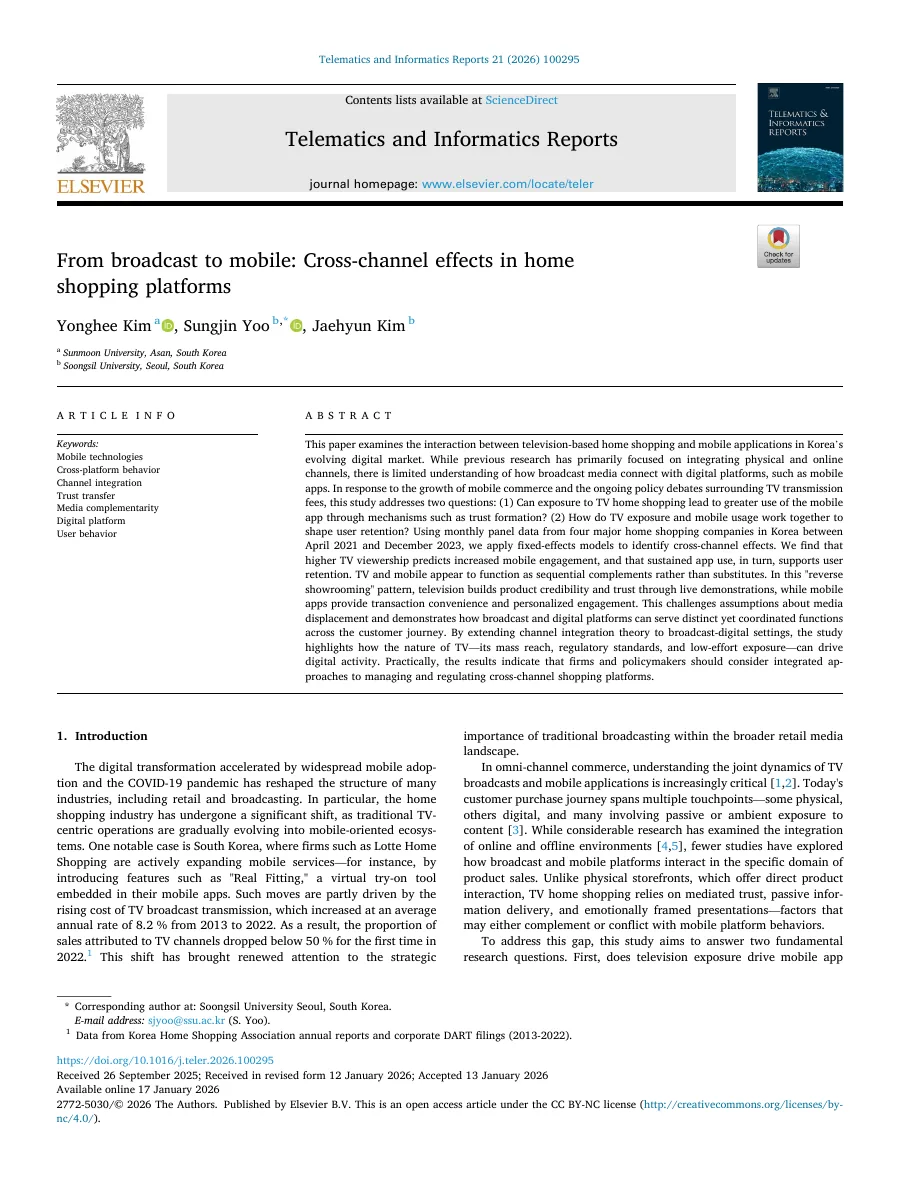
PDF 파일 1, 2, 4쪽PDF pages 1, 2, 4
4개 기업의 33개월 패널A 33-month panel of four firms
분석 대상은 국내 주요 홈쇼핑 4개사의 2021년 4월~2023년 12월 월별 자료로, 기본 범위는 132개 기업·월 관측치입니다. TV 가구 도달률과 시청 관련 변수, 앱 총 이용시간·이용자 수·신규 설치·이탈, 모바일 매출과 유지율 등을 연결합니다.
The basic panel covers four major Korean home-shopping firms for April 2021–December 2023, or 132 firm-month observations before model-specific temporal alignment. Variables connect household TV reach and audience measures with total app usage, users, installations, churn, mobile sales and retention.
이 자료는 기업별 월간 집계입니다. 특정 개인이 TV를 본 다음 같은 상품을 앱에서 샀는지 추적하는 자료가 아니며, 유지율은 관측된 앱 성과 지표입니다. 뒤의 계수도 개인 고객의 행동확률과 동일하게 해석할 수 없습니다.
These are monthly firm aggregates, not records tracing individual viewers from a television exposure to an app purchase. Retention is an app-performance measure. The regression coefficients therefore should not be interpreted as individual consumers’ transition probabilities or proof that the same people moved between channels.
PDF 파일 4, 5쪽PDF pages 4, 5
같은 기업의 시간 변화와 다음 달 성과 비교Within-firm changes and subsequent outcomes
기업 고정효과는 브랜드·품목 전략처럼 단기간에 잘 바뀌지 않는 차이를 통제합니다. TV 노출과 다음 시점의 모바일 이용, 모바일 참여와 이후 유지율을 연결해 시간 순서를 고려했습니다. 서로 다른 참여 지표로 결과가 반복되는지도 확인합니다.
Firm fixed effects control persistent differences such as brands and product strategies. The models align TV exposure with subsequent mobile outcomes and mobile engagement with later retention. Alternative user-count and usage-intensity specifications test whether the pattern depends on one particular measure of engagement.
방법을 쉽게 말하면, 평소보다 TV 도달이 높았던 달 뒤에 앱 활동도 높아지는지를 같은 회사 안에서 비교한 것입니다. 다만 시차를 사용해도 프로모션·상품 구성·경쟁 상황 등 모든 동시 변화를 제거하지는 못하므로 실험에서 얻은 인과효과와 구분해야 합니다.
In practical terms, the analysis asks whether a firm experiences stronger app activity after months with greater television reach than usual. Temporal ordering helps interpretation but cannot remove every promotional, assortment or competitive change. The estimates remain observational associations rather than experimental causal effects.
PDF 파일 5, 6, 7쪽PDF pages 5, 6, 7
도달률은 앱 참여, 참여는 유지율과 양의 관계Reach predicts engagement, and engagement predicts retention
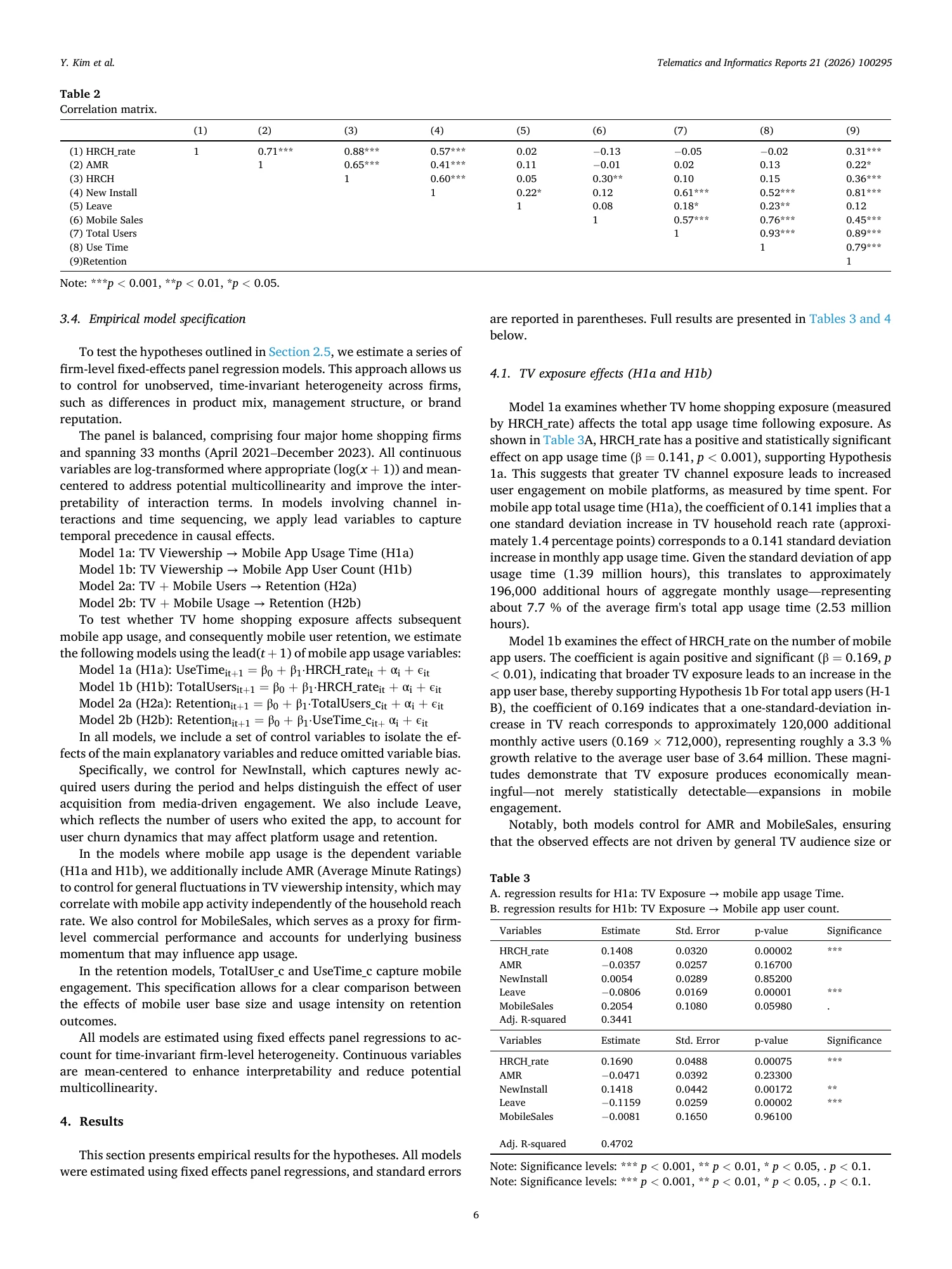
TV 도달률은 앱 이용시간에 0.1408, 앱 이용자 수에 0.1690의 양의 계수로 나타났으며 각각 p=0.00002와 p=0.00075였습니다. 원문은 표준편차 기준 변화량을 이용해 이 관계의 규모를 설명합니다. 이 계수를 TV 시청자 한 명당 증가 이용자 수로 바꾸어 말해서는 안 됩니다.
TV household reach has positive coefficients of 0.1408 for app usage time and 0.1690 for app user count, with reported p-values of 0.00002 and 0.00075. The paper explains their scale using standard-deviation changes. These coefficients are not extra app users per additional individual television viewer.
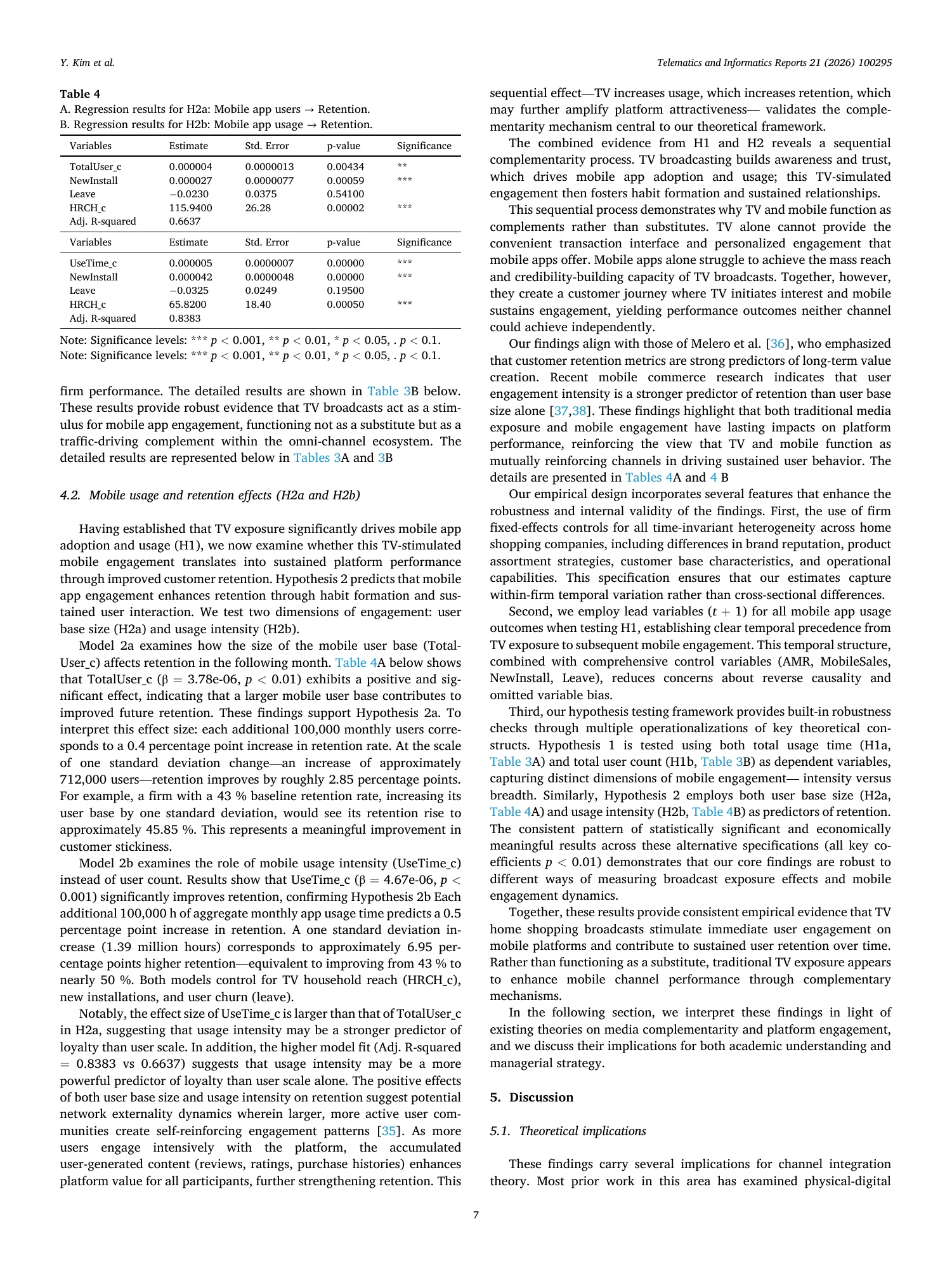
다음 단계에서는 앱 이용자 수와 이용시간 모두 이후 유지율과 유의한 양의 관계를 보였습니다. 이용시간 모형의 수정 R²는 0.8383, 이용자 수 모형은 0.6637입니다. 이용의 깊이가 중요하다는 해석과 일치하지만, 모형 적합도의 차이만으로 하나가 본질적으로 더 우수한 원인이라고 단정할 수는 없습니다.
Both app user count and usage time are positively associated with later retention. Adjusted R² is 0.8383 in the usage-time specification versus 0.6637 in the user-count model. This supports attention to engagement intensity, although different model fit alone does not establish a uniquely superior causal driver.
PDF 파일 6, 7쪽PDF pages 6, 7
핵심 결과를 표로 읽기Read the key results in tables
| 결과변수Outcome | TV 도달률 계수TV reach coefficient | 표준오차Standard error | p |
|---|---|---|---|
| 앱 이용시간App usage time | 0.1408 | 0.0320 | 0.00002 |
| 앱 이용자 수App user count | 0.1690 | 0.0488 | 0.00075 |
원문 표 3A·3B에서 HRCH_rate 행을 발췌했습니다. 같은 기업의 월별 자료를 사용한 모형이며 개인 전환율이 아닙니다.HRCH_rate rows from Tables 3A and 3B. These are monthly firm-level model estimates, not individual conversion rates.
원문 표 3A·3B 발췌Selected rows from original Tables 3A and 3B · PDF 파일 6쪽PDF page 6
원문의 핵심 표·그래프Key tables & figures in the source
표·그림이 수록된 원문 페이지입니다. 이미지를 누르면 확대할 수 있습니다.Original pages containing the selected tables or figures. Select an image to enlarge it.
TV 노출과 앱 참여TV exposure and app engagement
앱 참여와 이후 유지율App engagement and subsequent retention
채널별 지표와 조직을 연결하기Connect channel metrics and responsibilities
저자는 TV를 인지도·신뢰 형성, 앱을 탐색·거래·재참여의 접점으로 해석합니다. 실무적으로는 즉시 TV 매출만으로 방송의 가치를 평가하기보다 이후 앱 참여와 유지 지표를 함께 볼 필요가 있다는 제안입니다. QR·연계 프로모션 같은 수단은 이 해석에서 나온 활용 아이디어이지 이번 연구에서 별도 실험한 처방은 아닙니다.
The discussion assigns television an awareness and credibility role and apps a search, transaction and re-engagement role. It suggests evaluating broadcast investments alongside downstream engagement and retention. QR links and coordinated promotions are managerial applications of that interpretation, not separately tested interventions in this dataset.
PDF 파일 7, 8쪽PDF pages 7, 8
집계 자료에서 개인의 신뢰 이전을 단정할 수 없음Aggregate data do not establish individual trust transfer
4개 기업과 한국의 규제·유통구조에 한정된 결과입니다. 신뢰 형성이나 습관은 해석의 기제이며 직접 측정한 개인 심리 결과가 아닙니다. 품목별·연령별 차이, 양방향 관계와 다른 시차 설정의 검토가 더 필요합니다. 원문 자료는 비공개로 명시되어 있어 홈페이지의 표 재정리와 독립 재분석도 구분합니다.
Four firms in Korea’s institutional setting limit external validity. Trust transfer and habit formation are proposed mechanisms rather than directly measured individual psychological outcomes. Product segments, age groups, bidirectional dynamics and alternative lags require further work. The underlying data are confidential, so this explanation is not an independent reanalysis.
PDF 파일 8, 9쪽PDF pages 8, 9
근거 쪽: Evidence pages: 1, 2, 4, 5, 6, 7, 8, 9 · PDF 파일 기준, 인쇄 쪽수와 다를 수 있습니다. · PDF file pagination may differ from printed page numbers. 원문 출처 ↗Source ↗
원문 이미지 보기 · 1장View original document images · 1
서지 정보Bibliographic information
- 학술지Journal
- Telematics and Informatics Reports
- 권Volume
- 21
- 논문 번호Article number
- 100295
- 게재Published
- 2026-03
- 색인Indexing
-
- SCOPUS (저자 실적 기록 기준)(per the author's records)
- 인용Citations
- Google Scholar 인용 0Cited by 0 (Google Scholar) (새 창) (opens in a new tab) (2026-09-27 기준)(as of 2026-09-27)
인용하기Cite APA · BibTeX
APA
Kim, Y., Yoo, S., & Kim, J. (2026). From broadcast to mobile: Cross-channel effects in home shopping platforms. Telematics and Informatics Reports, 21, Article 100295. https://doi.org/10.1016/j.teler.2026.100295
BibTeX
@article{kim2026-homeshopping,
  author = {Kim, Yonghee and Yoo, Sungjin and Kim, Jaehyun},
  title = {From broadcast to mobile: Cross-channel effects in home shopping platforms},
  journal = {Telematics and Informatics Reports},
  year = {2026},
  volume = {21},
  eid = {100295},
  doi = {10.1016/j.teler.2026.100295}
}