창조산업의 디지털 투입·네트워크 위치와 글로벌 가치사슬Digital inputs, network position, and global value chains in creative industries
원문 제목: Digital inputs, network position, and global value chains in creative industries
번역 제목은 이 사이트의 편집 번역입니다. 서지와 인용에는 원문 제목을 사용합니다.Translated titles are editorial translations for this site. Bibliographic records and citations retain the original title.
Technological Forecasting & Social Change, 234, 논문 번호 124905Article 124905
2026-10-09 온라인 공개 · 2027-01 권호. 표기 연도는 배정된 권호 기준입니다.Published online 2026-10-09 · January 2027 issue. The citation year follows the assigned issue.
요약Summary
80개 경제권의 1995~2022년 시청각 산업 자료를 분석해 글로벌 가치사슬 참여가 수렴하지 않고 서로 다른 경로 집단으로 나뉜다는 점을 보였다. 전체 ICT 투입 비중의 직접 효과보다 IT·소프트웨어와 통신 투입 구성, 국제 생산 네트워크에서의 위치가 중요하게 나타났다.
Using audiovisual-sector data for 80 economies from 1995 to 2022, the study finds persistent clubs of global value-chain participation rather than convergence. Aggregate ICT input share has no significant direct effect; the composition of digital inputs and a country’s production-network position are more informative.
한눈에 보기At a glance
- 자료 기간Data period
- 1995 – 2022
- 방법Methods
- Panel Data Analysis
- Network Analysis
- Convergence Club Analysis
- Spatial Econometric Analysis
- 키워드Keywords
- Global Value Chains
- Creative Industries
- Digital Inputs
- Network Position
- Digitalization
- Value Capture
- Production Networks
원문을 바탕으로 연구의 논리와 결과를 풀어쓴 해설입니다. 수치는 표시한 표와 쪽을 기준으로 읽습니다. 아래 표는 핵심 항목을 웹에서 읽도록 재구성했고, 원문 표·그림이 있는 페이지를 함께 제공합니다.This reading guide explains the paper’s reasoning and findings in new wording. Tables below re-present selected source results for web reading, alongside images of the relevant original pages.
디지털 투자가 국제 제작망 참여로 이어지는가Do digital inputs translate into global production participation?
디지털 장비와 소프트웨어를 갖추면 모든 나라의 콘텐츠 산업이 세계시장에 더 쉽게 진입할까요? 이 논문은 기술 투입 자체와 국제 생산 네트워크에서 차지하는 위치를 구분합니다. 연구의 질문은 디지털 투입이 시청각 산업의 글로벌 가치사슬 참여와 어떻게 연결되고, 그 연결이 국가 간 격차를 줄이는지에 있습니다.
The paper asks whether digital inputs help countries join audiovisual global value chains, and whether this process closes international gaps. It separates the amount of technology purchased from a country’s position in international production relationships. The central issue is therefore relational access to production, rather than technology availability alone.
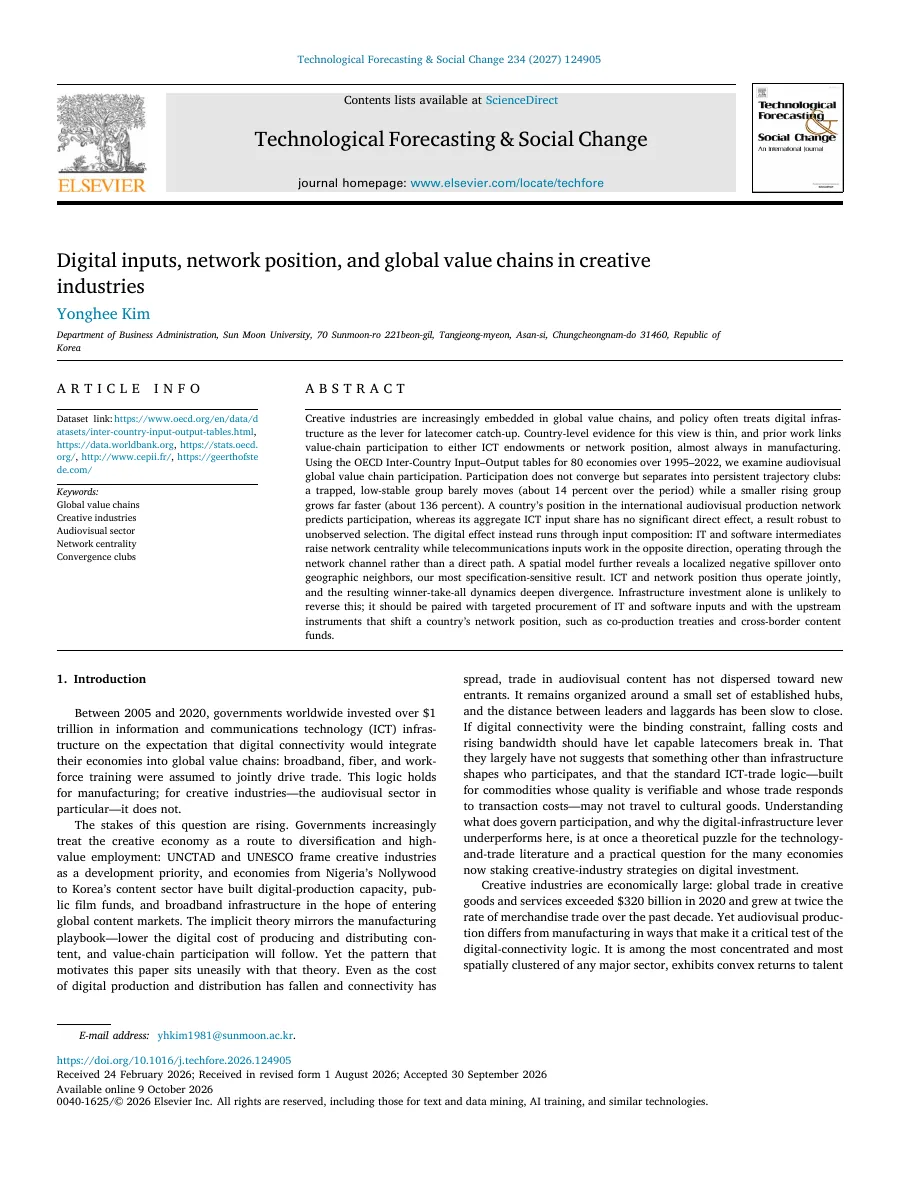
발행 시점은 두 가지로 구분해야 합니다. 출판본은 2026년 10월 9일 온라인 공개되었고, 배정된 권호는 2027년 234권입니다. 따라서 온라인 공개연도와 권호 기준 서지연도가 다른 자료입니다.
The publication chronology has two dates: the article became available online on 9 October 2026, while its assigned issue is volume 234 in 2027. Online availability and the bibliographic issue year should be retained separately.
PDF 파일 1, 3, 4쪽PDF pages 1, 3, 4
자료와 변수의 범위Data and measurement
OECD 국제산업연관표를 이용해 80개 경제권의 1995~2022년 자료를 구성했습니다. 종속변수는 국제 생산에서 창출되는 부가가치를 바탕으로 한 가치사슬 참여 지수이며, 주요 설명변수는 생산 네트워크 중심성과 ICT 중간재 투입 비중입니다. 관측치 수는 변수의 확보 범위에 따라 모형별로 달라집니다.
The study assembles OECD inter-country input–output data for 80 economies over 1995–2022. The outcome is a value-added-based GVC participation index; key predictors are production-network centrality and the share of ICT intermediate inputs. Estimation samples vary with variable availability rather than forming one identical panel for every model.
여기서 시청각 부문 D58T60에는 출판·영상·방송이 함께 묶여 있습니다. 전체 ICT 변수는 D26과 D62T63 투입의 합이고, 별도로 분석한 통신 D61은 그 합계의 구성요소가 아닙니다. 'ICT를 통신과 소프트웨어로 단순 분해했다'고 읽으면 변수 정의가 달라집니다.
The D58T60 industry combines publishing, audiovisual activities and broadcasting. Aggregate ICT inputs combine D26 and D62T63, whereas telecommunications D61 is a separate alternative regressor. The later telecom/software comparison is therefore not an exhaustive arithmetic decomposition of the aggregate measure.
PDF 파일 4, 5, 6쪽PDF pages 4, 5, 6
나라별 고정 차이와 이웃 효과를 나누어 분석Separating country differences and neighboring-country associations
패널 고정효과 모형은 국가마다 지속되는 특성과 공통적인 연도 충격을 통제하고 같은 나라 안에서의 변화를 비교합니다. 추가적인 GMM·도구변수·민감도 분석은 내생성에 대한 점검이며, 공간 모형은 자기 나라의 직접 관계와 이웃 국가를 통한 간접 관계를 나눕니다.
Country and year fixed effects compare changes within economies while controlling persistent country differences and common time shocks. GMM, instrumental-variable and sensitivity analyses probe endogeneity. A spatial model then separates own-country associations from indirect associations transmitted through geographically defined neighbors.
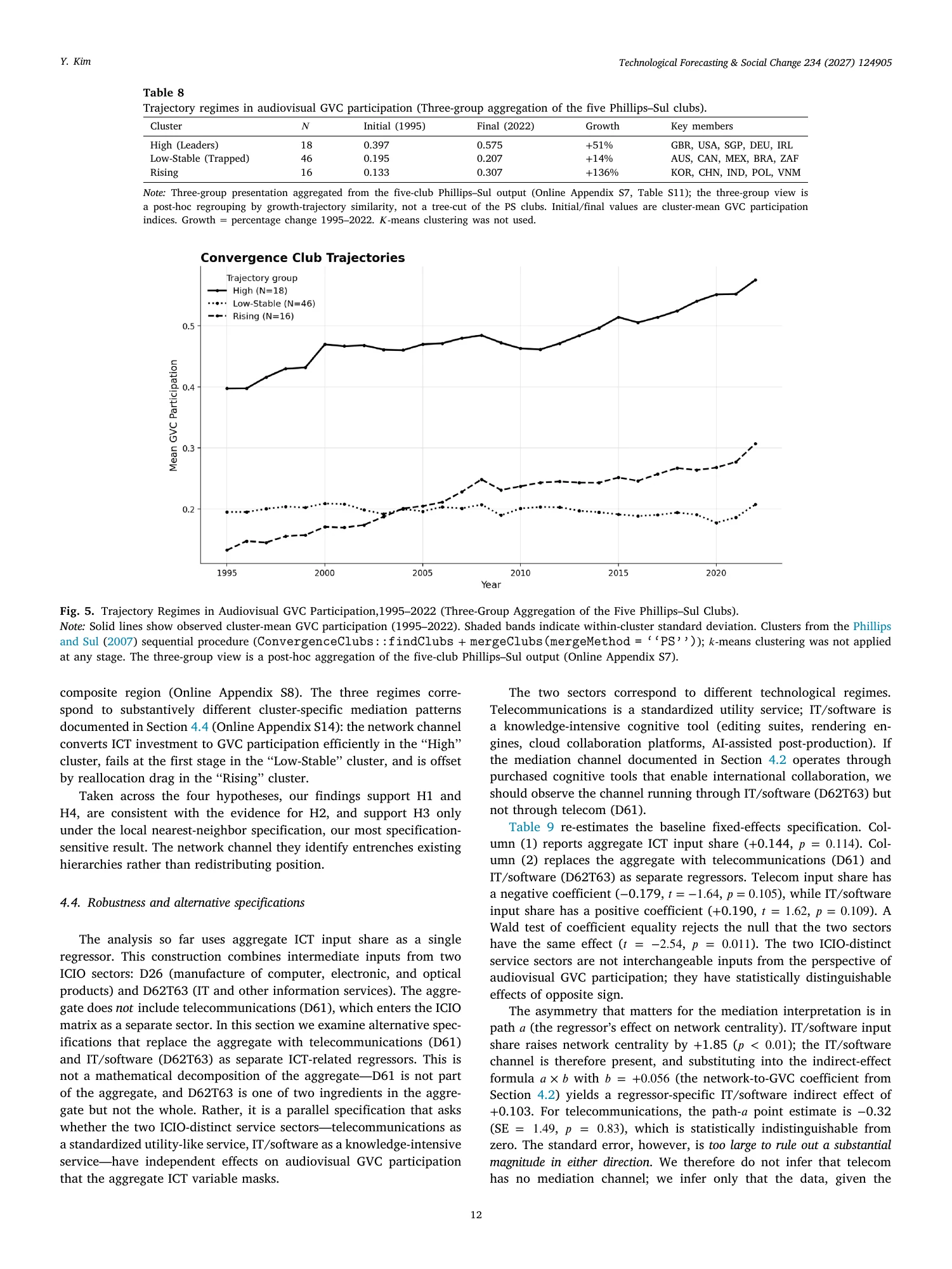
수렴 분석은 국가들이 하나의 경로로 모이는지, 여러 집단으로 남는지를 살핍니다. Phillips–Sul 절차의 다섯 집단을 설명용 세 집단으로 다시 묶었으며, 이를 k-means 군집분석의 결과로 소개하지 않습니다. 매개분석도 관측자료와 식별 가정에 의존하는 경로 분석입니다.
Phillips–Sul convergence analysis tests whether economies approach one trajectory or form separate clubs. Five statistical clubs are regrouped into three descriptive regimes; this is not k-means clustering. Mediation estimates describe a proposed network pathway and remain dependent on observational identification assumptions.
PDF 파일 7, 8, 10, 12, 13쪽PDF pages 7, 8, 10, 12, 13
네트워크 중심성은 안정적이고, ICT 효과는 모형에 민감Centrality is more stable than the aggregate ICT estimate
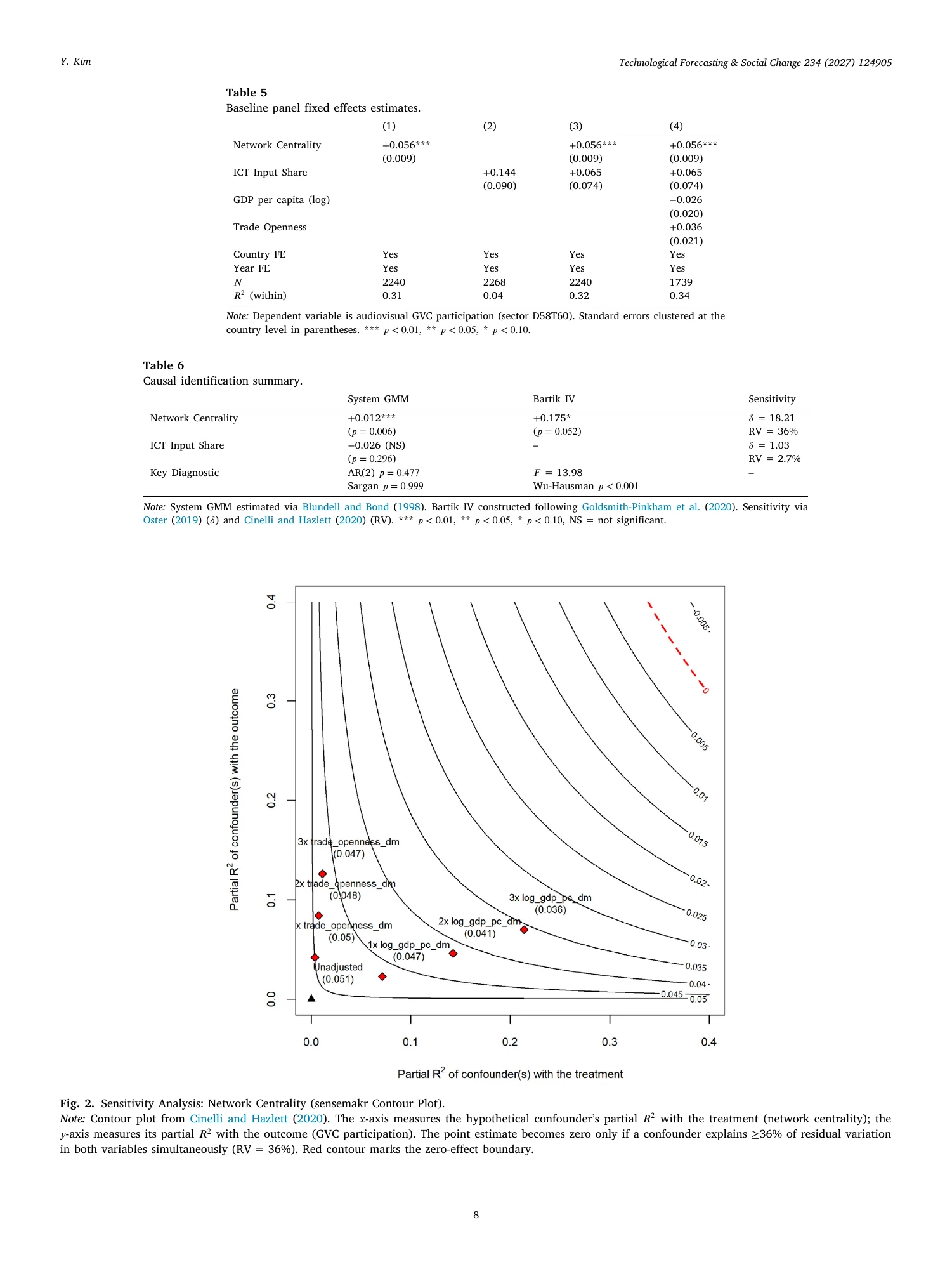
기본 고정효과 모형에서 네트워크 중심성 계수는 약 +0.056으로 유의하지만, ICT 비중의 직접 계수는 함께 투입한 모형에서 +0.065로 유의하지 않습니다. 이는 ICT가 쓸모없다는 뜻이 아니라, 총량만으로 가치사슬 참여 차이를 설명하기 어렵다는 결과입니다.
In the baseline fixed-effects models, network centrality has a positive coefficient near 0.056, whereas aggregate ICT share is not statistically significant when entered alongside centrality. This does not establish that digital inputs are useless; it indicates that their aggregate share alone does not explain participation consistently.
공간 모형에서는 ICT 직접 효과 +0.060, 간접 효과 −0.596이 보고됩니다. 다만 강한 음의 간접 효과는 여섯 최근접 이웃을 사용한 설정에 해당하며 다른 허용 가능한 이웃 정의에서는 유의하지 않습니다. 소프트웨어와 통신의 계수 차이 검정은 유의하지만, 각 직접 계수를 모두 유의한 효과라고 말할 수는 없습니다.
Under six-nearest-neighbor weights, ICT has a reported direct impact of +0.060 and indirect impact of −0.596. The strong negative spillover is specification-specific and is not significant under other admissible neighborhood definitions. Telecom and software coefficients differ statistically, although their separate direct coefficients are not both significant.
PDF 파일 8, 10, 12, 13쪽PDF pages 8, 10, 12, 13
핵심 결과를 표로 읽기Read the key results in tables
| 변수Variable | 모형 1Model 1 | 모형 3Model 3 | 모형 4Model 4 |
|---|---|---|---|
| 네트워크 중심성Network centrality | +0.056*** | +0.056*** | +0.056*** |
| ICT 투입 비중ICT input share | — | +0.065 | +0.065 |
| 관측치N | 2240 | 2240 | 1739 |
| 집단 내 R²Within R² | 0.31 | 0.32 | 0.34 |
원문 표 5의 선택 열. 괄호 표준오차는 생략. *** p<0.01. 계수는 확률의 퍼센트 변화가 아닙니다.Selected columns from Table 5; standard errors omitted. *** p<0.01. Coefficients are not percentage changes in probabilities.
원문 표 5 발췌Selected values from original Table 5 · PDF 파일 8쪽PDF page 8
원문의 핵심 표·그래프Key tables & figures in the source
표·그림이 수록된 원문 페이지입니다. 이미지를 누르면 확대할 수 있습니다.Original pages containing the selected tables or figures. Select an image to enlarge it.
기본 패널 추정과 식별 점검Baseline estimates and identification checks
가치사슬 참여의 서로 다른 경로 집단Different GVC-participation trajectories
설비와 국제 협업 관계를 함께 설계Design infrastructure and international relationships together
저자는 공동제작 관계, 국제 파트너 접근, 협업을 요구하는 지원제도처럼 네트워크를 만드는 정책을 강조합니다. 홈페이지에서는 이를 '특정 지원정책의 효과를 입증했다'가 아니라 연구가 제안하는 정책 방향으로 구분합니다. 설비지원의 성과지표에도 국제 제작관계 형성과 반복 협업을 포함할 근거를 제시합니다.
The policy discussion emphasizes co-production relationships, access to international partners and support programs that encourage collaboration. These are proposed directions, not separately identified effects of individual policy instruments. The findings suggest evaluating infrastructure support alongside the formation and persistence of international production relationships.
PDF 파일 14, 15쪽PDF pages 14, 15
공간 설정과 산업 묶음에 따른 해석 한계Limits of spatial specification and industry aggregation
국가 단위 자료로는 실제 기업의 계약·인력 이동·공동제작 중 어떤 경로가 작동했는지 직접 확인할 수 없습니다. 산업의 묶음과 일부 지역의 합산 처리, 매개분석에서 검증할 수 없는 교란 가정도 남습니다. 원문 표 8의 성장률 열은 제시된 시작·끝 평균값의 단순 변화율과 일치하지 않아 여기서는 해당 성장률을 재현하지 않습니다.
Country-level data cannot isolate particular contracts, talent flows or co-production mechanisms. Industry aggregation, residual-region coverage and untestable mediation assumptions limit interpretation. Table 8’s growth column does not align with a simple percentage change computed from its displayed endpoint means, so those growth percentages are not reproduced here.
PDF 파일 12, 15, 16쪽PDF pages 12, 15, 16
근거 쪽: Evidence pages: 1, 3, 4, 5, 6, 7, 8, 10, 12, 13, 14, 15, 16 · PDF 파일 기준, 인쇄 쪽수와 다를 수 있습니다. · PDF file pagination may differ from printed page numbers. 원문 출처 ↗Source ↗
원문 이미지 보기 · 1장View original document images · 1
서지 정보Bibliographic information
- 학술지Journal
- Technological Forecasting & Social Change
- 권Volume
- 234
- 논문 번호Article number
- 124905
- 출판사Publisher
- Elsevier
- 게재Published
- 2027-01
인용하기Cite APA · BibTeX
APA
Kim, Y. (2027). Digital inputs, network position, and global value chains in creative industries. Technological Forecasting & Social Change, 234, Article 124905. https://doi.org/10.1016/j.techfore.2026.124905
BibTeX
@article{kim2026-gvc-creative,
  author = {Kim, Yonghee},
  title = {Digital inputs, network position, and global value chains in creative industries},
  journal = {Technological Forecasting \& Social Change},
  year = {2027},
  volume = {234},
  eid = {124905},
  publisher = {Elsevier},
  doi = {10.1016/j.techfore.2026.124905}
}