경쟁하는 플랫폼 참여자는 파괴적 기술을 어떻게 규정하는가: 호텔과 온라인 여행사의 생성형 AI 위험 공시 쌍대 분석How Competing Platform Actors Frame a Disruptive Technology: A Dyadic Analysis of Generative-AI Risk Disclosure by Hotels and Online Travel Agencies
원문 제목: How Competing Platform Actors Frame a Disruptive Technology: A Dyadic Analysis of Generative-AI Risk Disclosure by Hotels and Online Travel Agencies
번역 제목은 이 사이트의 편집 번역입니다. 서지와 인용에는 원문 제목을 사용합니다.Translated titles are editorial translations for this site. Bibliographic records and citations retain the original title.
저자 표시: Author notes: 굵은 글씨: 김용희Bold: Yonghee Kim 교신저자Corresponding author
Journal of Theoretical and Applied Electronic Commerce Research, 21(10), 논문 번호 339Article 339색인: Indexed in: SSCI
요약Summary
호텔 운영사 4곳과 온라인 여행사 3곳의 2019~2025회계연도 위험 공시 49건을 분석했다. 경쟁사의 AI 역량을 위협으로 보는 서술은 온라인 여행사에서만 관찰됐고, 기업별 표현은 공통적인 법률 문구로 수렴했으며 위협 중심 서술의 비중은 시간이 지날수록 높아졌다.
The study analyzes 49 annual-report risk disclosures from four hotel operators and three online travel agencies over FY2019–2025. Rival-capability framing appears only among the agencies, while firm-specific wording converges toward boilerplate and threat-oriented framing intensifies over time.
한눈에 보기At a glance
- 자료 기간Data period
- FY2019 – FY2025
- 표본 크기Sample size
- N = 49
- 방법Methods
- Keyword-Anchored Text Extraction
- Thematic Coding
- Cross-Firm Cosine Similarity
- Stance Coding
- 키워드Keywords
- Generative AI
- Risk Disclosure
- Online Travel Agencies
- Disintermediation
- Text Mining
- Technology Framing
- Hotel Distribution
원문을 바탕으로 연구의 논리와 결과를 풀어쓴 해설입니다. 수치는 표시한 표와 쪽을 기준으로 읽습니다. 아래 표는 핵심 항목을 웹에서 읽도록 재구성했고, 원문 표·그림이 있는 페이지를 함께 제공합니다.This reading guide explains the paper’s reasoning and findings in new wording. Tables below re-present selected source results for web reading, alongside images of the relevant original pages.
같은 AI를 공급자와 중개자는 어떻게 다르게 설명하는가How suppliers and intermediaries describe the same AI
생성형 AI가 여행 검색과 예약 경로를 바꾸면 호텔과 온라인 여행사에 같은 위험이 생길까요? 이 논문은 호텔 운영사와 OTA가 서로 의존하면서 경쟁하는 관계에 주목합니다. AI를 도입한다는 언급의 양보다 위험을 어떤 주제로 설명하고 기회·위협 중 어디에 배치하는지를 분석합니다.
The paper asks how hotel operators and online travel agencies frame generative AI when it may reshape discovery and booking. These firms cooperate in distribution while competing for the customer interface. The analysis therefore examines the subjects and stance of risk disclosures, rather than treating every AI mention as equivalent.
PDF 파일 1, 8, 9쪽PDF pages 1, 8, 9
49개 공시에서 추출한 75개 생성형 AI 문장Seventy-five GenAI passages from 49 disclosures
호텔 운영사 4곳과 OTA 3곳의 2019~2025 회계연도 연차보고서 위험요인 공시 49건이 대상입니다. 전체 19,721문장 중 AI 관련 문장 290개를 찾고, 명시적인 생성형 AI·LLM·에이전트 표현이 있는 75문장을 엄격 부분집합으로 분류했습니다. 서로 다른 문장은 66개이고 나머지는 연도 간 반복입니다.
The corpus contains 49 annual-report risk-factor sections from four hotel operators and three OTAs for FY2019–2025. Of 19,721 sentences, 290 contain AI anchors and 75 meet stricter generative-AI criteria. The strict subset contains 66 distinct texts, with repeated wording across years making up the remainder.
엄격 부분집합은 2023회계연도부터 등장합니다. OTA 문장 51개 중 42개가 Booking Holdings에서 나와 문장 단위 비중과 기업별 동일 가중 비중을 함께 읽어야 합니다. 7개 기업은 목적표집이며 호텔·여행산업 전체의 확률표본이 아닙니다.
Strict GenAI passages first appear in FY2023. Booking Holdings supplies 42 of the 51 OTA passages, making passage-weighted and equal-firm-weighted summaries importantly different. The seven firms were selected purposively to represent a supplier–intermediary relationship, not randomly sampled to estimate industry-wide prevalence.
PDF 파일 8, 9, 19쪽PDF pages 8, 9, 19
주제·문장 유사성·평가 방향을 교차 확인Cross-checking themes, similarity and stance
문장은 검색·중개 배제, 경쟁사 역량, 자체 도입, 도입 책임·규제, 일반 서술이라는 다섯 주제로 코딩했습니다. 모델 보조 코딩의 반복과 저자의 이견 조정을 기록하고, 문장 유사도는 기업들이 같은 법률 문구로 수렴하는지를 살피는 데 사용했습니다. 같은 분량을 뽑는 통제로 문장이 길어진 효과도 분리합니다.
Passages are coded into discovery/disintermediation, rival capabilities, own deployment, deployment liabilities/compliance, and general description. Repeated model-assisted coding and author adjudication are documented. Cross-firm cosine similarity measures common phrasing, while an equal-content control helps separate linguistic convergence from the growth of disclosure volume.
기회·위협·중립이라는 입장 코딩은 별도 측정입니다. 작은 문장 집합에서 나온 빈도는 탐색적 기술 결과로 제시하며, 보조적으로 시도한 시장효과 모형은 적절한 통제집단과 검정력이 부족해 경제적 효과의 검증 근거로 쓰지 않습니다.
Opportunity, threat and neutral stance are coded separately. Counts from this small corpus are exploratory descriptions. Supplementary market-effect exercises lack clean controls or adequate power, so they are not interpreted as evidence for or against actual economic consequences of generative AI.
PDF 파일 9, 10, 11, 13, 14쪽PDF pages 9, 10, 11, 13, 14
경쟁사 역량은 OTA에서만, 공통 문구는 빠르게 확산Rival capabilities appear only on the OTA side
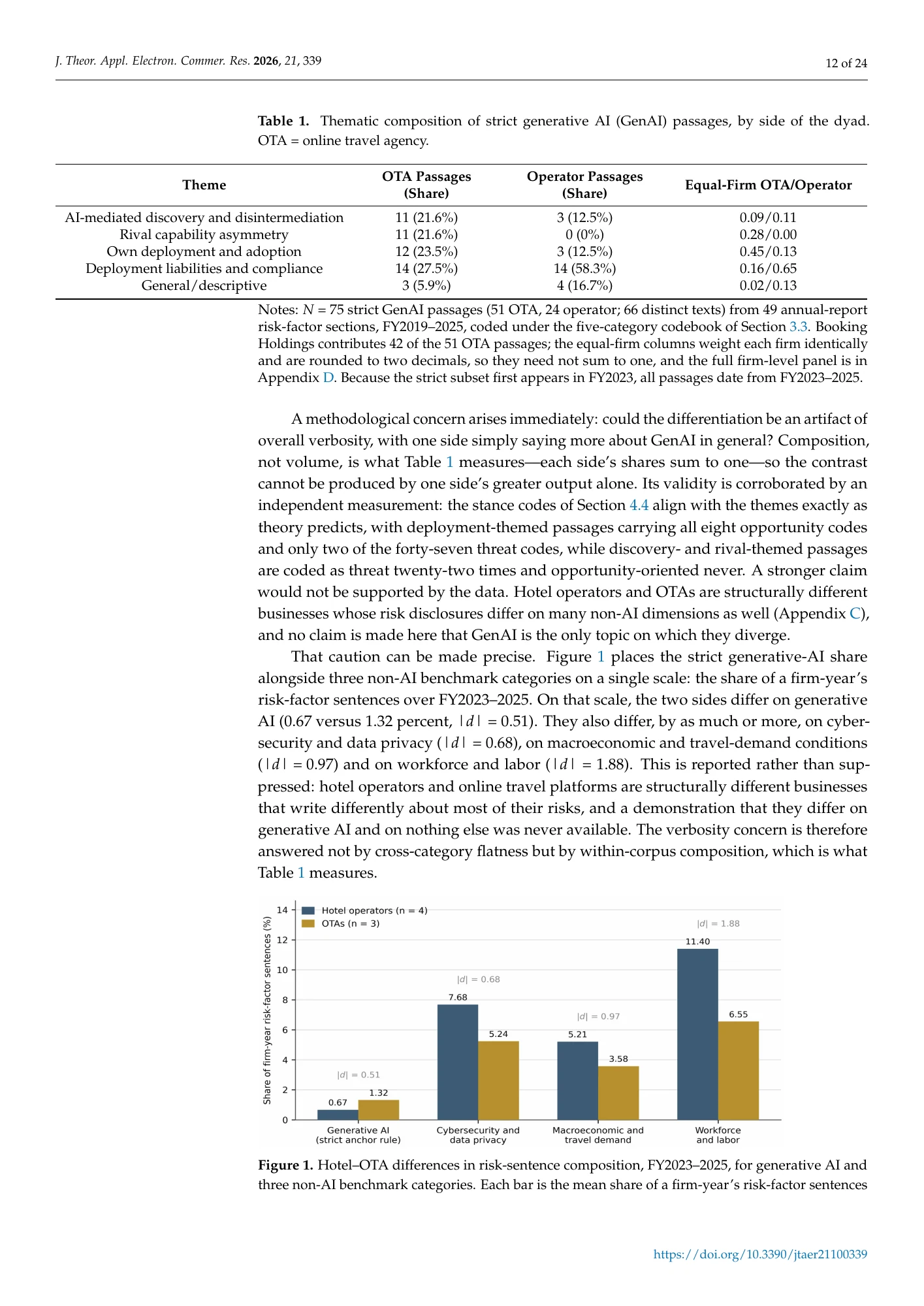
경쟁사 역량 비대칭 주제는 OTA 11문장, 호텔 0문장이었습니다. 반면 도입 책임·규제 주제는 OTA 14문장과 호텔 14문장으로 같지만, 각각의 전체 문장에서 차지하는 비중은 27.5%와 58.3%로 다릅니다. 개수와 구성비를 함께 보는 이유입니다.
Rival-capability asymmetry appears in 11 OTA passages and none from hotel operators. Deployment liabilities and compliance account for 14 passages on each side, but represent 27.5% of OTA text and 58.3% of operator text. Equal counts can therefore conceal substantially different thematic compositions.
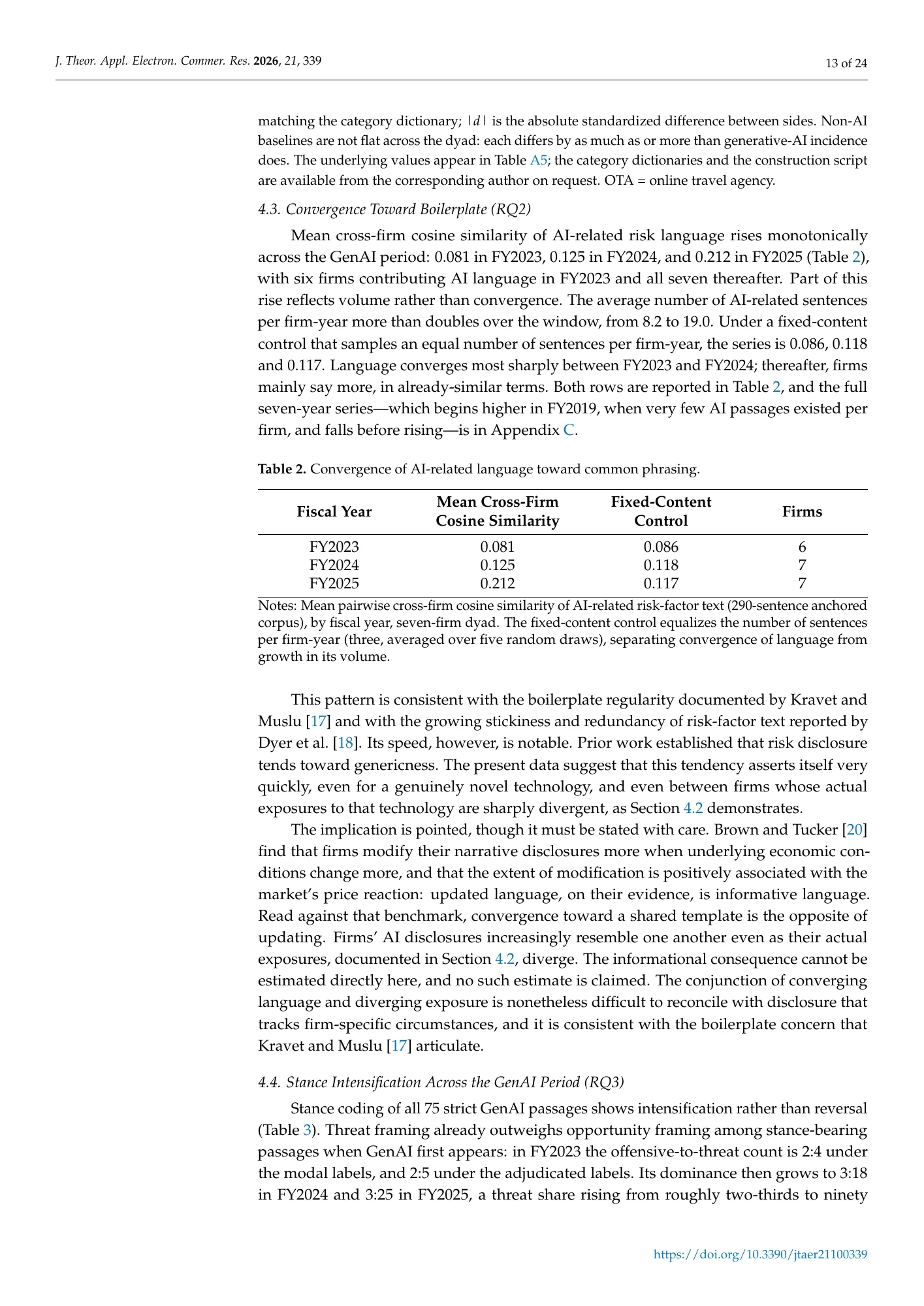
원시 유사도는 2023년 0.081에서 2025년 0.212로 높아졌으나 동일 분량 통제값은 2024년 0.118, 2025년 0.117로 거의 같습니다. 위협 비중도 입장이 있는 문장 중 67%에서 89%로 높아졌습니다. 이를 기업 내부의 확신 변화나 실제 시장손실로 바로 치환할 수는 없습니다.
Raw cosine similarity rises from 0.081 in 2023 to 0.212 in 2025, but equal-content values are nearly flat between 2024 and 2025: 0.118 and 0.117. Threat shares among stance-bearing passages rise from 67% to 89%. Neither pattern directly measures internal beliefs or realized market losses.
PDF 파일 12, 13, 14쪽PDF pages 12, 13, 14
핵심 결과를 표로 읽기Read the key results in tables
| 주제Theme | OTA 문장·비중OTA count/share | 호텔 문장·비중Operator count/share |
|---|---|---|
| 검색·중개 배제Discovery | 11 (21.6%) | 3 (12.5%) |
| 경쟁사 역량Rival capability | 11 (21.6%) | 0 (0%) |
| 자체 도입Own deployment | 12 (23.5%) | 3 (12.5%) |
| 책임·규제Liabilities & compliance | 14 (27.5%) | 14 (58.3%) |
| 일반 서술General | 3 (5.9%) | 4 (16.7%) |
원문 표 1의 문장 기준 비중. OTA 51, 호텔 24문장. 기업 동일 가중 비중과 다르며 산업 전체 추정치가 아닙니다.Passage-weighted values from Table 1: 51 OTA and 24 operator passages. These differ from equal-firm weights and are not industry-population estimates.
원문 표 1 발췌Selected columns from original Table 1 · PDF 파일 12쪽PDF page 12
원문의 핵심 표·그래프Key tables & figures in the source
표·그림이 수록된 원문 페이지입니다. 이미지를 누르면 확대할 수 있습니다.Original pages containing the selected tables or figures. Select an image to enlarge it.
AI와 비AI 공시의 기업 위치별 차이AI and non-AI disclosure differences
분량 통제 전후의 문구 유사도Similarity before and after content-volume control
공시를 읽을 때 기업 고유의 위험을 찾기Look for firm-specific information in disclosure
학술적으로는 기술 위협의 평가가 기업의 가치사슬 위치와 연결될 수 있다는 설명을 제시합니다. 공시를 읽는 사람에게는 'AI 위험'이라는 공통 표현보다 해당 기업의 거래 경로·경쟁자·책임 범위를 특정하는 문장이 더 중요할 수 있습니다. 이는 정보의 질에 관한 함의이며 주가 반응을 측정한 결론은 아닙니다.
The theoretical contribution links technological framing to a firm’s distribution position. For disclosure readers, passages identifying particular channels, competitors and liabilities may be more informative than generic AI-risk language. This is an implication for interpreting information quality; the paper does not estimate the resulting stock-market response.
PDF 파일 15, 16쪽PDF pages 15, 16
문장의 변화와 사업의 변화는 별개Disclosure changes are not business outcomes
단일 산업 관계와 7개 기업, 한 기업에 집중된 OTA 문장, 반복된 법률 표현이 해석 범위를 제한합니다. 위협 언어의 증가는 전략적 위험 인식일 수도, 법률상 방어 문구 확대일 수도 있습니다. 내부 의사결정이나 실제 예약경로 자료 없이 두 설명을 확정적으로 가를 수 없습니다.
A single dyad, seven firms, OTA concentration and repeated legal language restrict generalization. More threat language could reflect strategic escalation or defensive legal drafting. Public filings alone cannot distinguish those explanations decisively or establish changes in actual hotel booking channels.
PDF 파일 14, 16, 17쪽PDF pages 14, 16, 17
근거 쪽: Evidence pages: 1, 8, 9, 10, 11, 12, 13, 14, 15, 16, 17, 19 · PDF 파일 기준, 인쇄 쪽수와 다를 수 있습니다. · PDF file pagination may differ from printed page numbers. 원문 출처 ↗Source ↗
원문 이미지 보기 · 1장View original document images · 1
서지 정보Bibliographic information
- 학술지Journal
- Journal of Theoretical and Applied Electronic Commerce Research
- 권(호)Volume (issue)
- 21(10)
- 논문 번호Article number
- 339
- 출판사Publisher
- MDPI
- 게재Published
- 2026-09-26
- 색인Indexing
-
- SSCI (저자 실적 기록 기준)(per the author's records)
- 전문Full text
- 공개 전문Open-access version (새 창) (opens in a new tab) · CC BY
인용하기Cite APA · BibTeX
APA
Kim, Y., Wang, S.-S., & Yoo, S. (2026). How Competing Platform Actors Frame a Disruptive Technology: A Dyadic Analysis of Generative-AI Risk Disclosure by Hotels and Online Travel Agencies. Journal of Theoretical and Applied Electronic Commerce Research, 21(10), Article 339. https://doi.org/10.3390/jtaer21100339
BibTeX
@article{kim2026-ai-risk-disclosure,
  author = {Kim, Yonghee and Wang, Shi-Shiuan and Yoo, Sungjin},
  title = {How Competing Platform Actors Frame a Disruptive Technology: A Dyadic Analysis of Generative-{AI} Risk Disclosure by Hotels and Online Travel Agencies},
  journal = {Journal of Theoretical and Applied Electronic Commerce Research},
  year = {2026},
  volume = {21},
  number = {10},
  eid = {339},
  publisher = {MDPI},
  doi = {10.3390/jtaer21100339}
}