글로벌 금융투자 연결성·ICT·지식재산 전략: 국가 단위 실증 분석Global Financial Investment Connectedness, ICT, and Intellectual Property Strategies: A Country-Level Empirical Analysis
원문 제목: Global Financial Investment Connectedness, ICT, and Intellectual Property Strategies: A Country-Level Empirical Analysis
번역 제목은 이 사이트의 편집 번역입니다. 서지와 인용에는 원문 제목을 사용합니다.Translated titles are editorial translations for this site. Bibliographic records and citations retain the original title.
저자 표시: Author notes: 굵은 글씨: 김용희Bold: Yonghee Kim 교신저자Corresponding author
Sustainability, 16(8), 논문 번호 3282Article 3282색인: Indexed in: SSCI
요약Summary
국가별 금융투자 네트워크와 ICT 이용이 지식재산 사용료 수입·지급으로 구분한 IP 전략과 맺는 관계를 분석했다. 유입 연결성과 매개 중심성은 서로 다른 방향으로 작용했고 ICT 이용은 IP 전략의 금융 네트워크 의존을 완화했다.
Country-level panel-logit models relate financial-network position and ICT use to IP strategies defined by receipts versus payments for intellectual-property use. Incoming connectedness and betweenness have different associations, while ICT use weakens the strategy’s reliance on financial-network connectedness.
한눈에 보기At a glance
- 자료 기간Data period
- 2001 – 2015
- 표본 크기Sample size
- N = 2,326
- 방법Methods
- Panel Logit Model
- Social Network Analysis
- Interaction Analysis
- 키워드Keywords
- Financial Networks
- ICT Development
- Intellectual Property
- Panel Logit
- Network Analysis
- IP Strategy
- Global Investment
원문을 바탕으로 연구의 논리와 결과를 풀어쓴 해설입니다. 수치는 표시한 표와 쪽을 기준으로 읽습니다. 아래 표는 핵심 항목을 웹에서 읽도록 재구성했고, 원문 표·그림이 있는 페이지를 함께 제공합니다.This reading guide explains the paper’s reasoning and findings in new wording. Tables below re-present selected source results for web reading, alongside images of the relevant original pages.
금융 네트워크의 위치와 IP 수지의 관계Financial-network position and IP trade balance
국제 투자가 많이 연결된 나라는 지식재산을 더 많이 만들어 파는 나라가 될까요, 아니면 외부 기술을 더 많이 사는 나라가 될까요? 이 연구는 국제 금융 네트워크에서 직접 투자를 받는 연결과 다른 나라 사이를 잇는 위치를 구분합니다. 분석 대상은 IP 보호법의 엄격함이 아니라 사용료 수입·지급으로 정의한 전략 유형입니다.
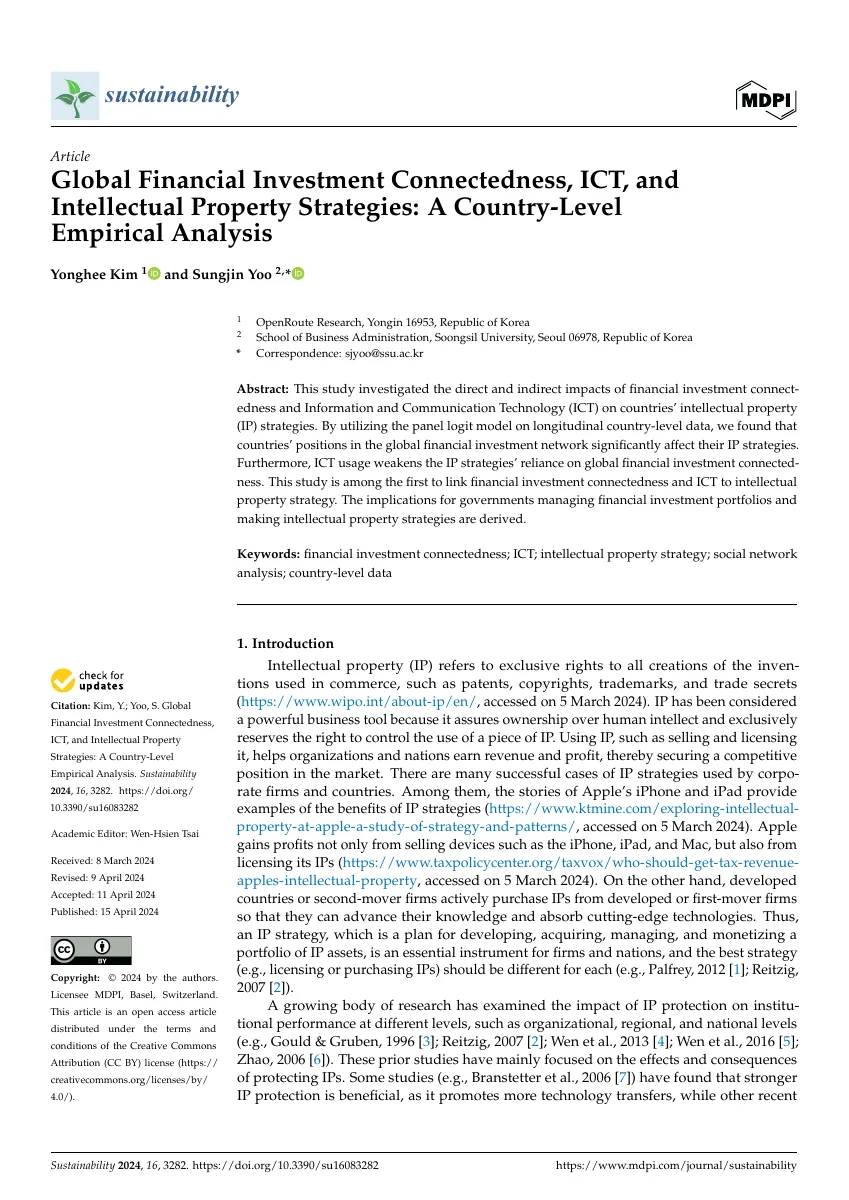
The paper asks whether countries’ positions in international investment networks relate to earning more from IP or purchasing more IP abroad. It distinguishes direct incoming connections from brokerage positions. Crucially, the outcome is a strategy proxy based on IP receipts and payments, not the strength of intellectual-property protection law.
PDF 파일 1, 3, 4쪽PDF pages 1, 3, 4
수집 범위와 실제 추정 표본을 구분Distinguish the collected corpus from the estimation sample
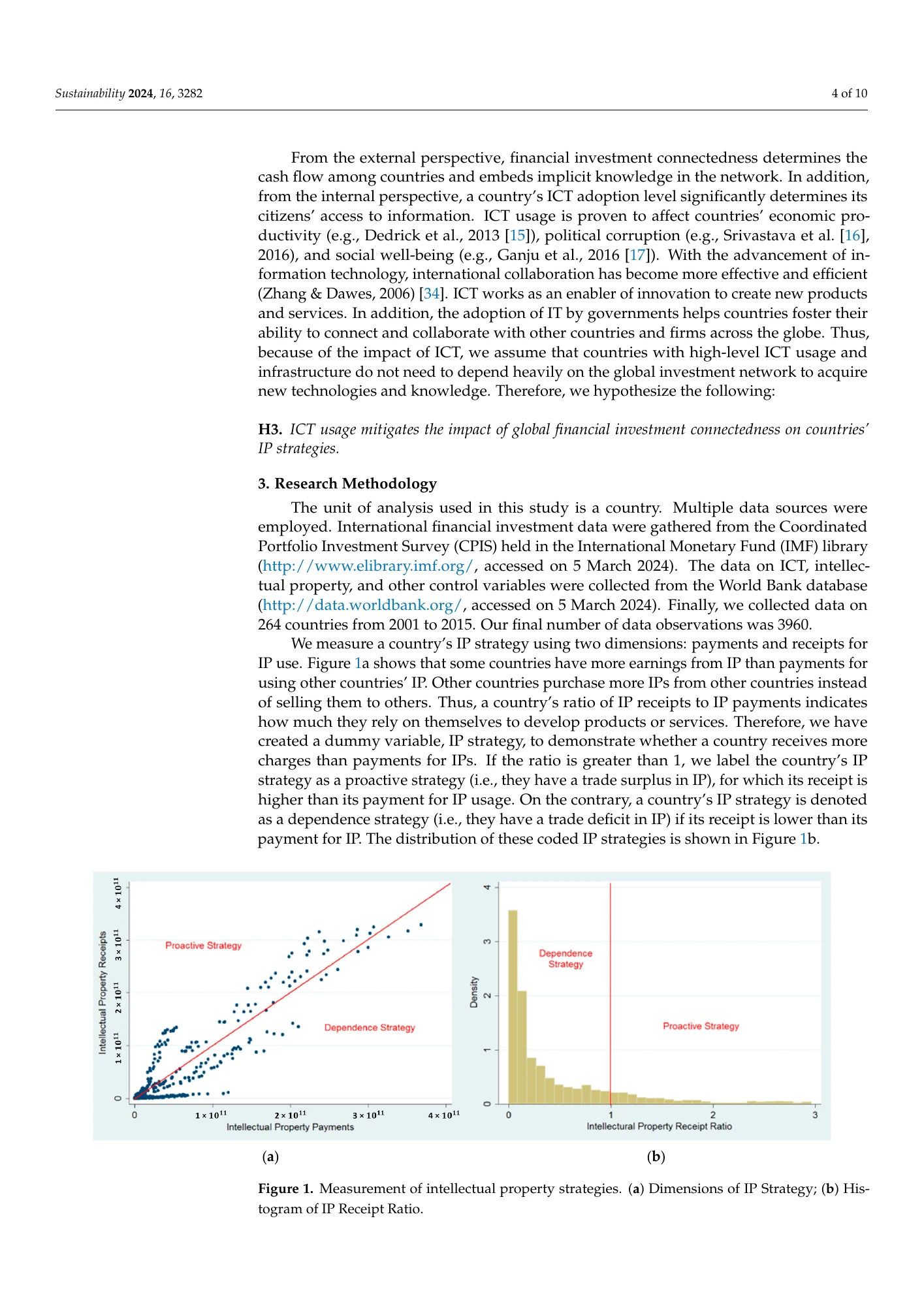
2001~2015년 IMF CPIS 금융투자 자료와 World Bank의 ICT·IP 및 통제변수를 연결했습니다. 본문은 264개국 3,960개 관측치의 수집 범위를 설명하지만, 결과표 2의 추정 표본은 결측 처리 후 222개국 2,326개 관측치입니다. 홈페이지의 분석 표본은 후자를 기준으로 소개합니다.
IMF CPIS investment data are combined with World Bank ICT, IP and control variables for 2001–2015. The text describes an initial collection of 264 countries and 3,960 observations; Table 2 reports the estimation sample as 222 countries and 2,326 observations after availability restrictions. These scopes should not be conflated.
IP 사용료 수입이 지급보다 크면 1인 적극형, 반대이면 의존형으로 분류합니다. ICT는 인구 100명당 유선전화·인터넷·모바일 이용을 합한 지표입니다. 금융 연결은 방향은 있지만 투자 금액으로 가중하지 않은 네트워크이며 GDP·인구·교육·FDI 등도 통제합니다.
A country is coded proactive when IP receipts exceed payments, and dependent otherwise. ICT combines fixed-line, internet and mobile use per 100 people. The investment network is directed but unweighted, and controls include GDP, population, education and inward FDI. Thus connection counts are distinct from investment amounts.
PDF 파일 4, 5, 6, 7쪽PDF pages 4, 5, 6, 7
국가별 전략의 확률과 상호작용을 추정Estimate strategy likelihood and interactions
종속변수가 두 유형이므로 랜덤효과 패널 로짓을 사용하고 설명변수를 시차 처리했습니다. 유입 차수는 직접 연결의 수, 매개 중심성은 네트워크 경로 사이를 잇는 위치를 나타냅니다. ICT와 각 중심성의 상호작용은 디지털 이용 수준에 따라 관계가 달라지는지를 검사합니다.
A random-effects panel logit model is used for the binary strategy outcome, with lagged predictors. Incoming degree captures direct links, while betweenness captures a country’s position along network paths. Interaction terms test whether the centrality–strategy relationship changes with ICT use; probit and alternative outcome thresholds provide robustness comparisons.
로짓 계수는 확률이 아니라 로그오즈 척도이며 상호작용을 포함한 주효과는 기준 ICT 수준에 조건부입니다. 따라서 계수 2.820을 '확률이 282% 증가'라고 번역할 수 없습니다. 시차와 통제가 관측되지 않은 국가 특성이나 역인과 가능성을 모두 제거하는 것도 아닙니다.
Logit coefficients are on a log-odds scale, and main effects in an interaction model are conditional on the ICT reference value. A coefficient of 2.820 is not a 282% probability increase. Lagging and controls also do not eliminate every unobserved country characteristic or source of reverse causation.
PDF 파일 5, 6, 7쪽PDF pages 5, 6, 7
직접 연결과 중개 위치는 같은 방향이 아님Direct connections and brokerage have different signs
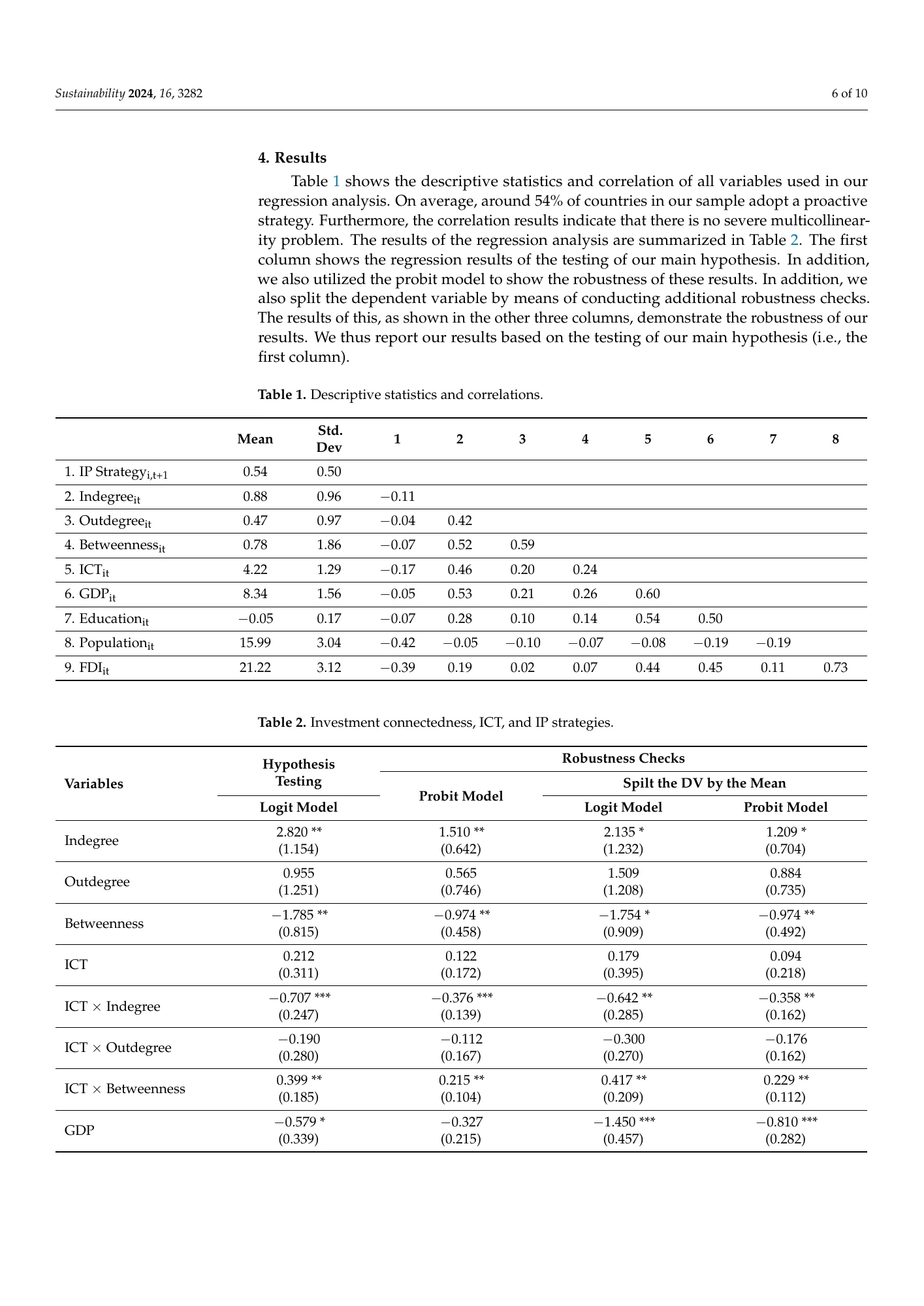
주모형의 유입 차수 계수는 +2.820(p<0.05), 매개 중심성은 −1.785(p<0.05)입니다. 유출 차수 0.955와 ICT 단독 계수 0.212는 유의하지 않습니다. 금융망에 더 많이 연결된다는 말을 하나의 효과로 묶기보다 어떤 종류의 연결인지를 구분해야 합니다.
The main logit model reports +2.820 for incoming degree and −1.785 for betweenness, both significant at 5%. Outgoing degree (0.955) and ICT alone (0.212) are insignificant. Different forms of connectedness therefore should not be collapsed into one general claim that more networking always favors the same IP strategy.
ICT×유입 차수는 −0.707(p<0.01), ICT×매개 중심성은 +0.399(p<0.05)입니다. 부호 조합은 ICT가 높을 때 중심성 주효과의 방향을 약화시키는 패턴과 연결됩니다. 저자는 이를 금융망 의존 완화로 해석하지만 모든 국가·ICT 구간의 확률 효과를 계수표만으로 확정할 수는 없습니다.
The ICT-by-incoming-degree interaction is −0.707 (p<0.01), while ICT-by-betweenness is +0.399 (p<0.05). Their signs counter the corresponding main-effect directions, consistent with reduced dependence on network position. The coefficient table alone does not establish identical probability effects across countries and all ICT levels.
PDF 파일 6, 7쪽PDF pages 6, 7
핵심 결과를 표로 읽기Read the key results in tables
| 변수Variable | 계수Coefficient | 표준오차Robust SE |
|---|---|---|
| 유입 차수Incoming degree | 2.820** | 1.154 |
| 유출 차수Outgoing degree | 0.955 | 1.251 |
| 매개 중심성Betweenness | −1.785** | 0.815 |
| ICT | 0.212 | 0.311 |
| ICT × incoming degree | −0.707*** | 0.247 |
| ICT × betweenness | 0.399** | 0.185 |
표 2 첫 모형. N=2,326, 국가=222. *** p<0.01, ** p<0.05. 계수는 로그오즈이며 상호작용이 있어 주효과는 조건부입니다.First specification of Table 2: 2,326 observations, 222 countries. *** p<0.01, ** p<0.05. Coefficients are log-odds and main effects are conditional in the interaction model.
원문 표 2 발췌Selected coefficients from original Table 2 · PDF 파일 6, 7쪽PDF pages 6, 7
원문의 핵심 표·그래프Key tables & figures in the source
표·그림이 수록된 원문 페이지입니다. 이미지를 누르면 확대할 수 있습니다.Original pages containing the selected tables or figures. Select an image to enlarge it.
IP 전략 유형의 정의Definition of the IP-strategy outcome
금융 연결과 ICT 상호작용Connectedness and ICT interactions
IP 전략을 자금과 정보 접근의 결합으로 보기Combine access to finance and information
IP 수지와 혁신 전략을 설명할 때 국내 연구개발 역량만이 아니라 해외 투자관계와 ICT 접근을 함께 살필 필요가 있다는 기여입니다. 정책적으로는 투자 유치 규모와 연결 형태를 구분하고 정보 접근의 보완 역할을 점검할 수 있습니다. 특정 ICT 사업이나 IP 법 개정의 효과를 검증한 연구는 아닙니다.
The contribution is to relate IP strategy to both external investment relationships and domestic information access. Policy interpretation should distinguish investment volume from connection structure and examine ICT’s complementary role. The paper does not identify the effect of a particular ICT program or change in IP legislation.
PDF 파일 7, 8쪽PDF pages 7, 8
IP 수지를 혁신 능력 전체로 확대하지 않기IP balance is not total innovative capability
사용료 수지는 국제기업의 회계·라이선스 구조 등에도 영향을 받을 수 있어 기술의 질이나 보호 수준 전체를 뜻하지 않습니다. 결측으로 달라진 국가 범위, 비가중 금융망, 오래된 분석 기간도 한계입니다. 원문 상호작용에 대한 문장 설명보다 표의 부호와 조건부 해석을 우선해 수치 의미를 명확히 했습니다.
IP balance can reflect licensing and multinational accounting structures as well as technological capability. Missing-data coverage, an unweighted investment network and the historical period restrict interpretation. Here the interaction signs and conditional coefficient meaning are stated explicitly rather than extending them into universal claims about innovation quality.
PDF 파일 4, 5, 7, 8쪽PDF pages 4, 5, 7, 8
근거 쪽: Evidence pages: 1, 3, 4, 5, 6, 7, 8 · PDF 파일 기준, 인쇄 쪽수와 다를 수 있습니다. · PDF file pagination may differ from printed page numbers. 원문 출처 ↗Source ↗
원문 이미지 보기 · 1장View original document images · 1
서지 정보Bibliographic information
- 학술지Journal
- Sustainability
- 권(호)Volume (issue)
- 16(8)
- 논문 번호Article number
- 3282
- 게재Published
- 2024-04-15
- 색인Indexing
-
- SSCI (저자 실적 기록 기준)(per the author's records)
- 인용Citations
- Google Scholar 인용 2Cited by 2 (Google Scholar) (새 창) (opens in a new tab) (2026-09-27 기준)(as of 2026-09-27)
인용하기Cite APA · BibTeX
APA
Kim, Y., & Yoo, S. (2024). Global Financial Investment Connectedness, ICT, and Intellectual Property Strategies: A Country-Level Empirical Analysis. Sustainability, 16(8), Article 3282. https://doi.org/10.3390/su16083282
BibTeX
@article{kim2024-global,
  author = {Kim, Yonghee and Yoo, Sungjin},
  title = {Global Financial Investment Connectedness, {ICT}, and Intellectual Property Strategies: A Country-Level Empirical Analysis},
  journal = {Sustainability},
  year = {2024},
  volume = {16},
  number = {8},
  eid = {3282},
  doi = {10.3390/su16083282}
}