방송 산업 내 플랫폼사업자와 콘텐츠사업자 간 공정거래환경 조성 연구Creating a Fair Trading Environment Between Platforms and Content Providers in Broadcasting
Original title: 방송 산업 내 플랫폼사업자와 콘텐츠사업자 간 공정거래환경 조성 연구
번역 제목은 이 사이트의 편집 번역입니다. 서지와 인용에는 원문 제목을 사용합니다.Translated titles are editorial translations for this site. Bibliographic records and citations retain the original title.
저자 표시: Author notes: 굵은 글씨: 김용희Bold: Yonghee Kim 교신저자Corresponding author
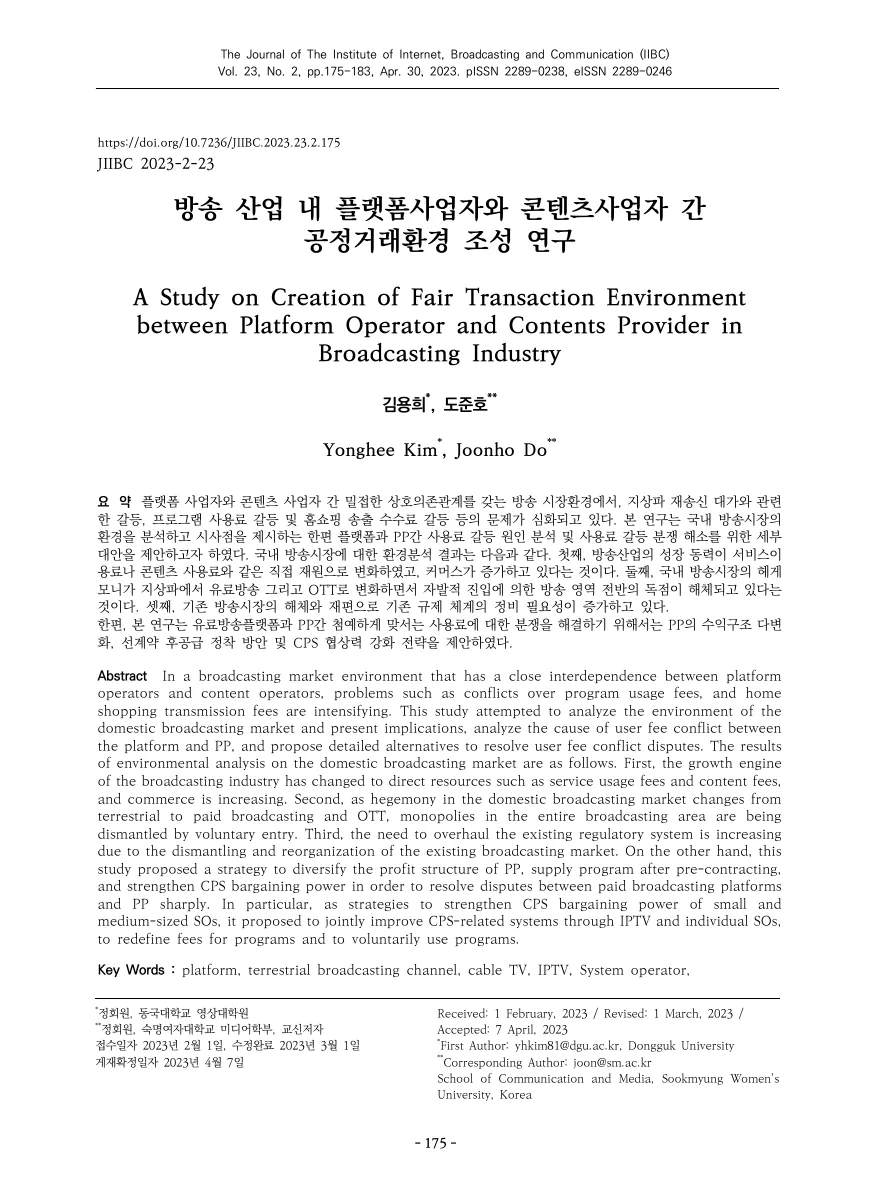
한국인터넷방송통신학회 논문지, 23(2), 175–183색인: Indexed in: KCI
요약Summary
방송 플랫폼과 콘텐츠 사업자 사이 사용료 갈등을 국내 방송시장 구조 변화와 함께 분석했다. PP 수익구조 다변화, 선계약 후공급 정착, 중소 SO의 재송신료 협상력 강화를 분쟁 해소의 대안으로 제안했다.
The paper analyzes fee disputes between broadcasting platforms and content providers in the context of Korean market restructuring. It proposes diversifying PP revenue, establishing contracts before supply, and improving smaller cable operators’ bargaining over retransmission fees.
한눈에 보기At a glance
- 방법Methods
- Market Structure Analysis
- Policy Analysis
원문을 바탕으로 연구의 논리와 결과를 풀어쓴 해설입니다. 수치는 표시한 표와 쪽을 기준으로 읽습니다. 아래 표는 핵심 항목을 웹에서 읽도록 재구성했고, 원문 표·그림이 있는 페이지를 함께 제공합니다.This reading guide explains the paper’s reasoning and findings in new wording. Tables below re-present selected source results for web reading, alongside images of the relevant original pages.
서로 필요한 방송사업자들은 왜 사용료로 충돌하는가Why do interdependent broadcasters dispute distribution fees?
방송 플랫폼은 시청자를 끌어들일 콘텐츠가 필요하고 콘텐츠 사업자는 유통 창구가 필요하지만, 제한된 재원을 나누는 과정에서는 이해가 충돌한다. 이 논문은 지상파 재송신료, 프로그램 사용료, 홈쇼핑 송출수수료 갈등을 그 상호의존성과 협상력의 문제로 살핀다. 연구 질문은 분쟁의 구조적 원인이 무엇이며, 반복적인 협상 갈등을 줄이는 공정거래환경을 어떻게 만들 수 있는가다.
Platforms need attractive programs, while content providers need distribution. Yet their interdependence does not eliminate conflict over a limited revenue pool. The paper examines terrestrial retransmission fees, program fees, and home-shopping carriage fees through bargaining power and market structure. It asks what drives recurring disputes and what institutional arrangements could create fairer trading conditions.
PDF 파일 1, 2, 3쪽PDF pages 1, 2, 3
재원·가입자·비용 추이를 모은 산업 분석Industry evidence on revenue, subscribers, and costs
방송사업자 재산상황 공표집, 정부 통계, 선행연구, 보도자료와 뉴스 사례를 함께 사용한다. 핵심 통계는 2015~2020년 순유입 재원, 2015~2018년 프로그램 구입비용, 2021년 전후 가입자와 매출 구조 등 서로 다른 기간의 자료다. 동일한 기업을 장기간 추적한 인과추정 패널이나 대표 설문은 아니다. 따라서 각 표의 기준연도와 재원 정의를 유지해야 하며, 논문 속 당시 수치를 현재 시장 규모로 소개해서는 안 된다.
The study assembles official financial disclosures, government statistics, prior research, and reported disputes. Different exhibits cover different periods, including 2015–2020 revenue inflows, 2015–2018 programming costs, and subscriber or revenue conditions around 2021. It is not a unified causal panel or representative survey. Each exhibit’s year and revenue definition therefore need to remain explicit.
PDF 파일 2, 3, 5, 7, 8쪽PDF pages 2, 3, 5, 7, 8
거래 구조의 변화를 대조해 대안을 도출Compare changing transaction structures to develop proposals
분석은 기술통계와 사례를 통해 재원 성장의 방향, 콘텐츠 집중, 플랫폼 간 규모 차이와 계약 절차를 연결하는 방식이다. 매출 증가와 콘텐츠 구매비용 증가의 속도를 비교하고, 콘텐츠 가치 산정과 계약 종료 규칙이 협상에서 어떤 역할을 하는지 논의한다. 저자들이 직접 밝히듯 정성적 정책연구에 가깝다. 표의 증가율 차이는 갈등이 생길 수 있는 배경을 보여주지만 특정 사업자의 행위가 가격이나 복지를 얼마나 변화시켰는지 식별하지는 않는다.
Descriptive trends and cases are linked to concentration, scale differences, valuation, and contracting rules. The authors compare revenue growth with programming-cost growth and examine how fee valuation and termination procedures shape bargaining. They explicitly characterize the work as largely qualitative. Diverging growth rates illustrate pressure points, but do not identify the causal welfare effect of a particular firm’s conduct.
PDF 파일 3, 4, 6, 8쪽PDF pages 3, 4, 6, 8
수신료보다 빠르게 증가한 콘텐츠 구매비용Programming costs grew faster than subscription revenue
표 4에서 2015~2018년 프로그램 사용료는 13,667억→17,670억원, 재송신료는 1,520억→3,184억원, 유료방송 수신료 매출은 27,544억→33,464억원이다. 원문 CAGR은 각각 8.9%, 28.0%, 6.7%다. 표 2에서는 2020년 순유입 재원이 90,500억원으로 제시되며, 산업 내부 거래를 포함한 전체 매출과 구별한다. 저자들은 이를 바탕으로 콘텐츠 수급비 인상 압박과 플랫폼 수익구조의 긴장을 설명하고, 대형과 중소 콘텐츠·플랫폼 사업자의 차이에도 주목한다.
Table 4 reports programming fees rising from KRW1.3667 trillion to KRW1.7670 trillion during 2015–2018, retransmission fees from KRW152.0 billion to KRW318.4 billion, and subscription revenue from KRW2.7544 trillion to KRW3.3464 trillion. Source-reported CAGRs are 8.9%, 28.0%, and 6.7%. Table 2 distinguishes net external inflows from total industry revenue, highlighting why gross turnover can exaggerate the distributable revenue pool.
PDF 파일 3, 4, 5쪽PDF pages 3, 4, 5
핵심 결과를 표로 읽기Read the key results in tables
| 항목Measure | 2015년(억원)2015, KRW100m | 2018년(억원)2018, KRW100m | 원문 CAGRReported CAGR |
|---|---|---|---|
| 방송프로그램 사용료Programming fees | 13,667 | 17,670 | 8.9% |
| 지상파 재송신료Terrestrial retransmission fees | 1,520 | 3,184 | 28.0% |
| 유료방송 수신료 매출Pay-TV subscription revenue | 27,544 | 33,464 | 6.7% |
원문 표 4 재구성. 프로그램 사용료는 기본·유료채널 및 유료 VOD를 포함하고, 재송신료는 지상파방송사 재송신 매출이다. 역사적 기술통계이며 비용 인상의 인과효과 추정치가 아니다.Adapted from Table 4. Programming fees include basic and premium channels and paid VOD; retransmission fees are terrestrial broadcasters’ retransmission revenue. These are historical descriptive figures, not causal estimates.
원문 표 4(연도별 재산상황 공표집·천혜선 2020 재구성)Original Table 4, based on annual financial disclosures and Cheon 2020 · PDF 파일 3쪽PDF page 3
원문의 핵심 표·그래프Key tables & figures in the source
표·그림이 수록된 원문 페이지입니다. 이미지를 누르면 확대할 수 있습니다.Original pages containing the selected tables or figures. Select an image to enlarge it.
표 2·4: 순유입 재원과 콘텐츠 구매비용Tables 2 and 4: Inflows and programming costs
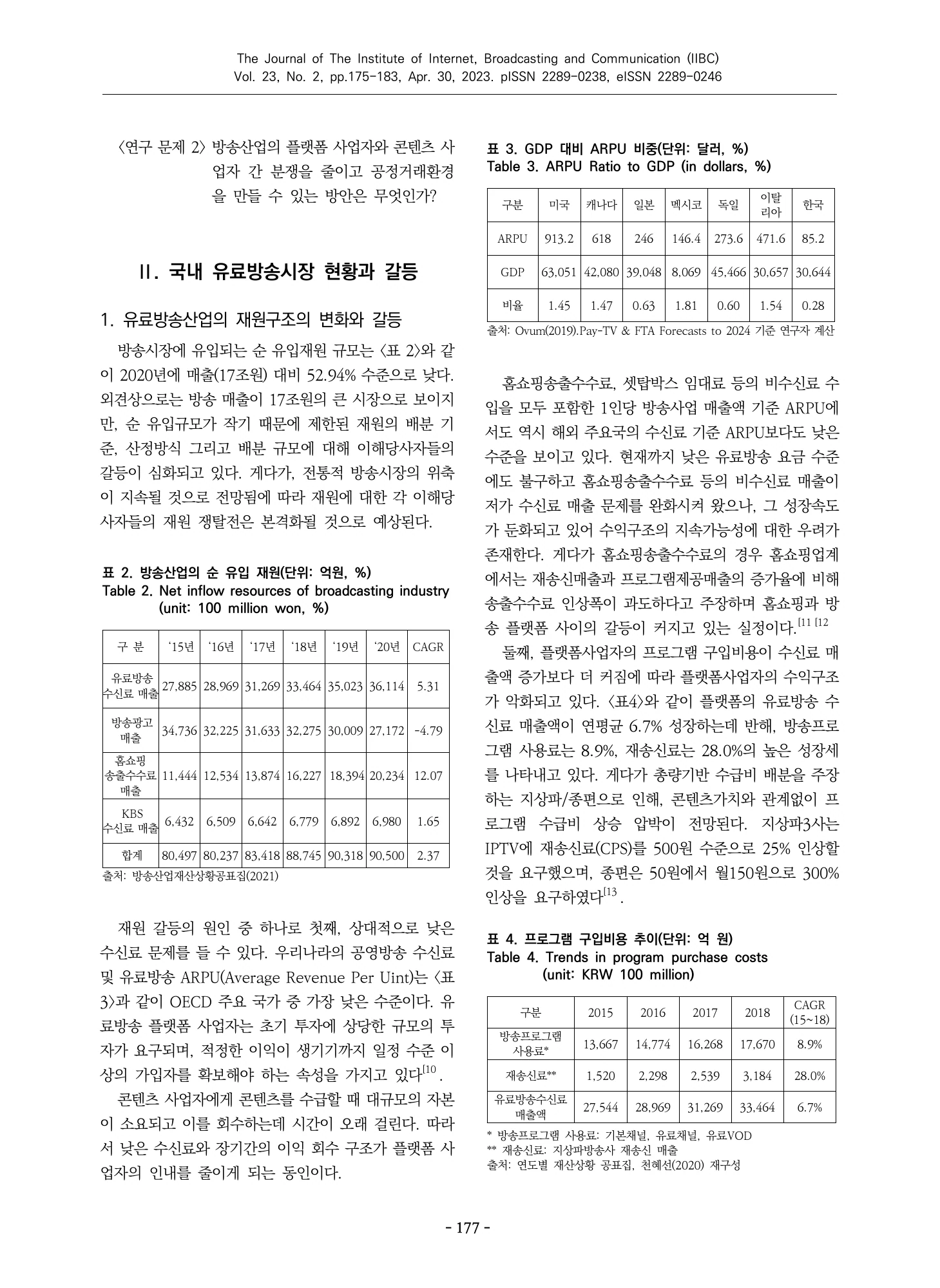
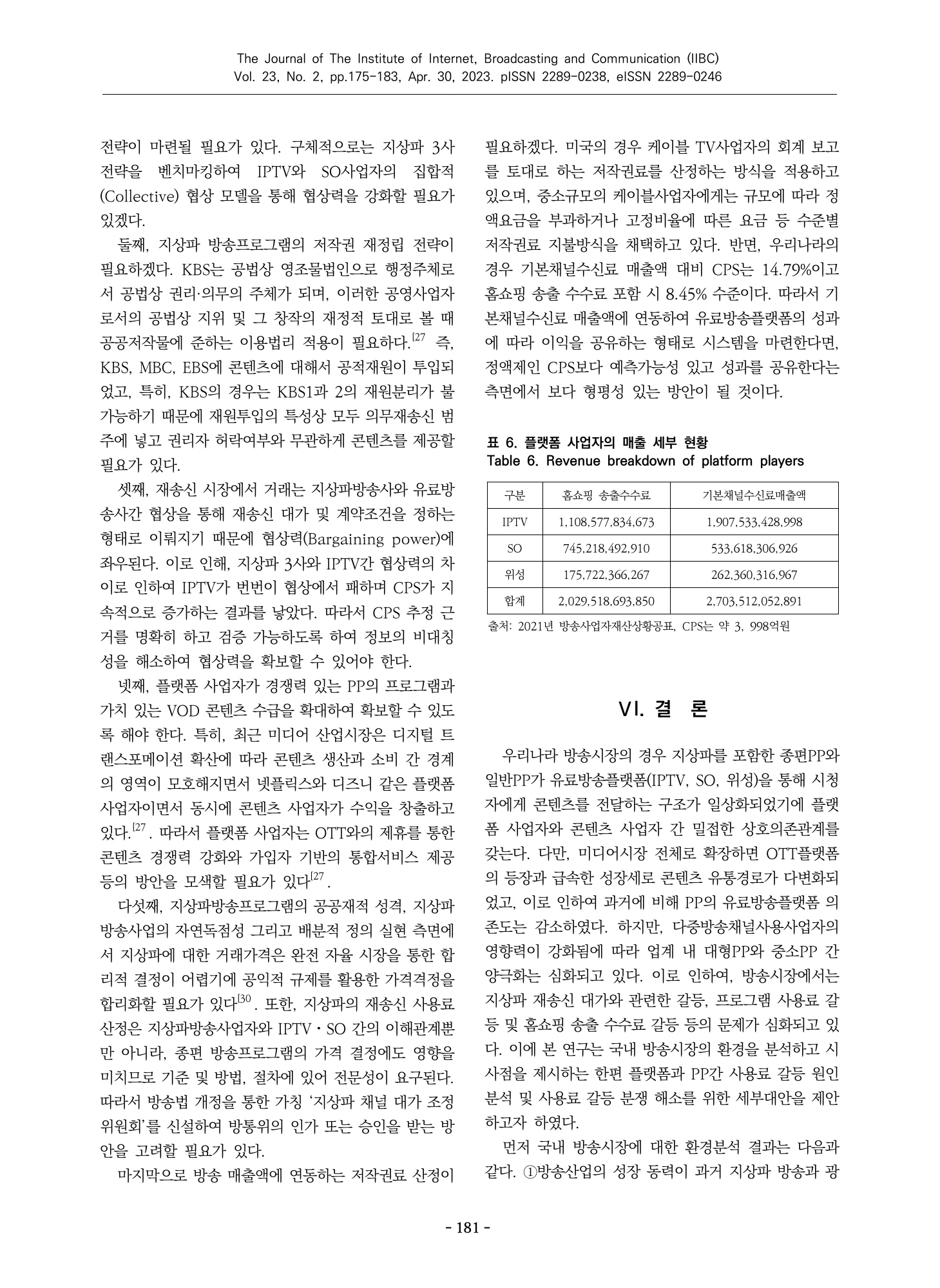
표 6: 플랫폼 사업자의 매출 세부 현황Table 6: Platform revenue breakdown
수익 다변화·계약 절차·협상력의 세 축Three proposals: revenue diversity, contracting, and bargaining
논문의 대안은 PP의 판권·유통 수익 다변화, 선계약 후공급 정착, 중소 SO의 CPS 협상력 강화다. 구체적으로 객관적 채널평가와 계약 종료 기준, 성실협상 가이드라인, 대가 산정 근거의 투명성, 집합적 협상 및 매출 연동 대가를 검토하자고 제안한다. 공영방송 프로그램의 권리 처리와 조정기구에 관한 주장도 포함한다. 이들은 저자의 정책 제안이며 이미 도입되어 효과가 검증된 제도나 확정된 저작권 해석은 아니다.
The proposed response has three strands: diversify PP licensing revenue, establish contracts before supply, and strengthen smaller cable operators’ CPS bargaining. Specific suggestions include objective channel evaluation, termination criteria, good-faith negotiation guidance, transparent fee bases, collective bargaining, and revenue-linked payments. These are the authors’ proposals, including contested public-broadcasting copyright arguments, rather than already validated reforms or settled legal interpretations.
PDF 파일 5, 6, 7, 8쪽PDF pages 5, 6, 7, 8
협상 갈등의 설명과 정책 효과의 증명을 구분Explaining a dispute is not demonstrating a reform’s effect
저자들은 기술통계와 문헌·뉴스에 기초한 접근이 정량연구보다 일반화에 제약이 있다고 명시한다. 사업자 유형별 이해관계가 다른 만큼 특정 대안을 전체 시장의 유일한 해법으로 제시하기도 어렵다. 수신료·재송신료의 비중은 분모와 기준연도에 민감하며, 비용 전가나 서비스 품질 저하는 논문이 제기한 우려로 구분해야 한다. 후속 과제는 계약·사업자 수준 자료에 기반한 정량 검증과 콘텐츠 제공사업자·플랫폼 간 다른 거래 갈등으로의 확장이다.
The paper acknowledges limited generalizability from descriptive evidence and documentary cases. Different operator interests also prevent treating one proposal as the unique solution. Fee ratios depend on denominators and years; consumer pass-through or quality deterioration are concerns raised by the authors, not estimated outcomes. Further work would require contract- or firm-level quantitative evidence and examination of related platform–content disputes.
PDF 파일 7, 8쪽PDF pages 7, 8
근거 쪽: Evidence pages: 1, 2, 3, 4, 5, 6, 7, 8, 9 · PDF 파일 기준, 인쇄 쪽수와 다를 수 있습니다. · PDF file pagination may differ from printed page numbers. 원문 출처 ↗Source ↗
원문 이미지 보기 · 1장View original document images · 1
서지 정보Bibliographic information
- 학술지Journal
- 한국인터넷방송통신학회 논문지
- 권(호)Volume (issue)
- 23(2)
- 쪽Pages
- 175–183
- 게재Published
- 2023-04-30
- 색인Indexing
-
- KCI (저자 실적 기록 기준)(per the author's records)
- 인용Citations
- Google Scholar 인용 2Cited by 2 (Google Scholar) (새 창) (opens in a new tab) (2026-09-27 기준)(as of 2026-09-27)
인용하기Cite APA · BibTeX
APA
김용희, 도준호 (2023). 방송 산업 내 플랫폼사업자와 콘텐츠사업자 간 공정거래환경 조성 연구. 한국인터넷방송통신학회 논문지, 23(2), 175–183. https://doi.org/10.7236/JIIBC.2023.23.2.175
BibTeX
@article{kci-2023-fair-trade,
  author = {김용희 and 도준호},
  title = {방송 산업 내 플랫폼사업자와 콘텐츠사업자 간 공정거래환경 조성 연구},
  journal = {한국인터넷방송통신학회 논문지},
  year = {2023},
  volume = {23},
  number = {2},
  pages = {175--183},
  doi = {10.7236/JIIBC.2023.23.2.175}
}