무엇이 한국 콘텐츠인가: 수용자의 판단에서 출발했습니다
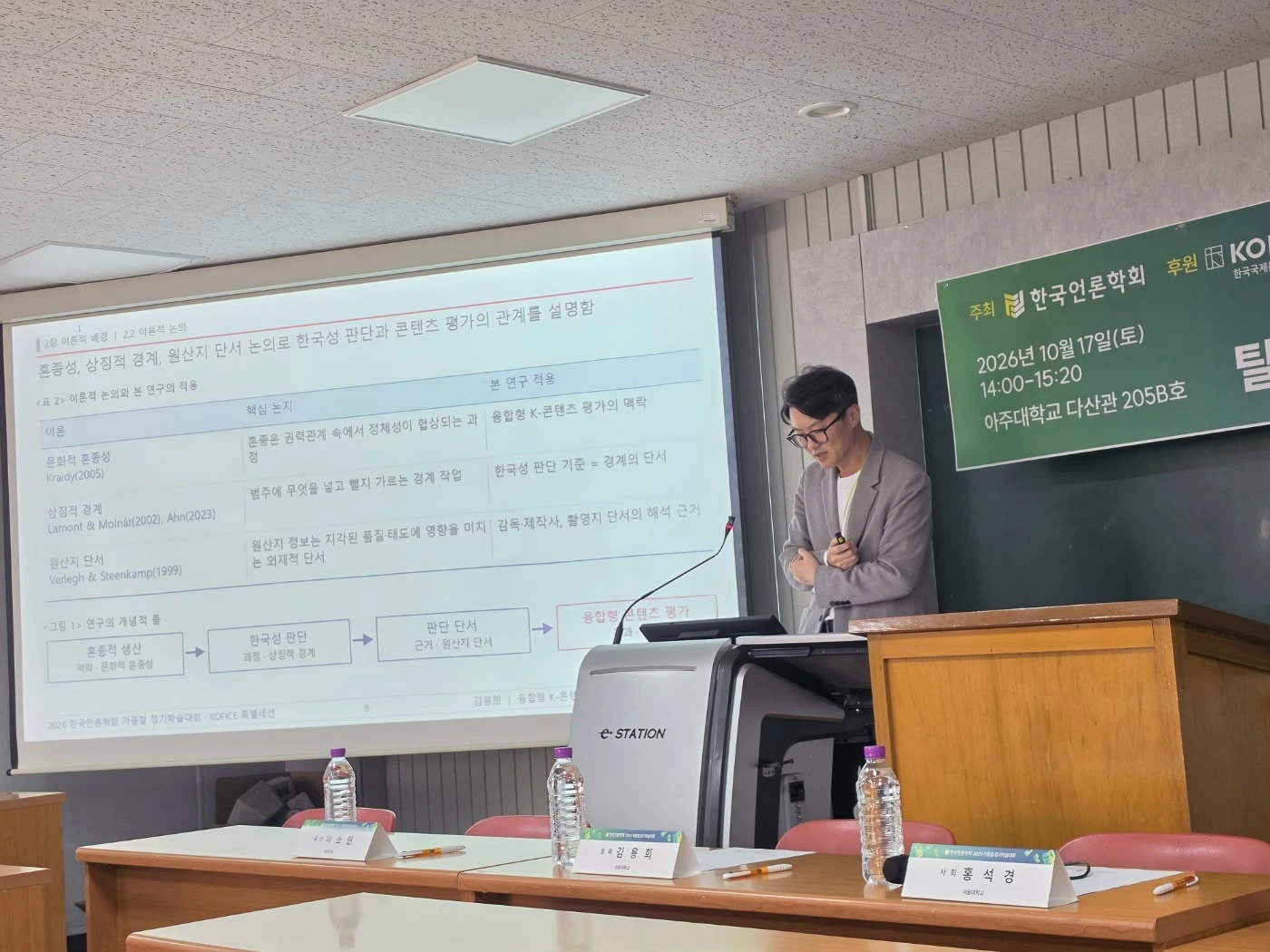
2026년 10월 17일 아주대학교에서 열린 한국언론학회 KOFICE 특별세션에서 「융합형 K-콘텐츠의 한국성 판단과 수용자 평가」를 발표했습니다. ‘NEXT 한류’가 국경을 넘는 제작과 문화적 혼종화를 논의하는 자리에서, 저는 해외 수용자가 무엇을 근거로 콘텐츠를 한국적이라고 분류하는지 실증적으로 살폈습니다.
발표의 핵심은 한국성을 판단하는 기준이 다양하며, 한국 감독·제작사를 기준으로 고른 집단의 융합형 콘텐츠 수용 용이성이 일관되게 높게 나타났다는 결과입니다. 이 관계가 곧 제작 주체 정보의 인과효과라는 뜻은 아닙니다.
자료와 방법: 30개 국가·지역, 한류 경험자 27,400명
2026 해외한류실태조사 원자료를 사용했습니다. 조사 대상은 30개 국가·지역의 만 15~59세 한국 문화콘텐츠 경험자이며, 온라인 패널을 통해 2025년 11월 13일~12월 12일 응답을 받았습니다. 전체 분석 표본은 27,400명입니다. 각국 일반 인구 전체를 대표하는 표본과는 구분해야 합니다.
한국성 판단의 가장 중요한 기준 하나를 고르게 한 문항을 여섯 범주로 나눴습니다. 융합형 콘텐츠 평가는 수용 용이성·독창성·트렌디성·매력성 네 문항입니다. 5점 척도 중 4~5점을 긍정 응답으로 분류해 각각 추정했습니다.
분석에는 사후가중치와 국가 고정효과를 적용한 로지스틱 회귀를 사용하고 성별·연령·학력·한국 인지도·이용 분야 수·국가 내 상대소득을 통제했습니다. 국가 군집 강건 표준오차를 사용했으며, 문화요소 집단을 기준으로 평균 한계효과(%p)를 비교했습니다(발표자료 12~18쪽).
결과 1: 한국성을 가르는 단서가 하나로 모이지 않습니다
| 가장 중요한 판단 기준 | 전체 가중 비율 |
|---|---|
| 한국 문화요소 | 23.3% |
| 한국 인물 | 21.8% |
| 한국 촬영지·배경 | 19.1% |
| 한국 감독·제작사 | 18.0% |
| 한국어 | 15.0% |
| 한국과 다른 국가의 공동제작 | 2.8% |
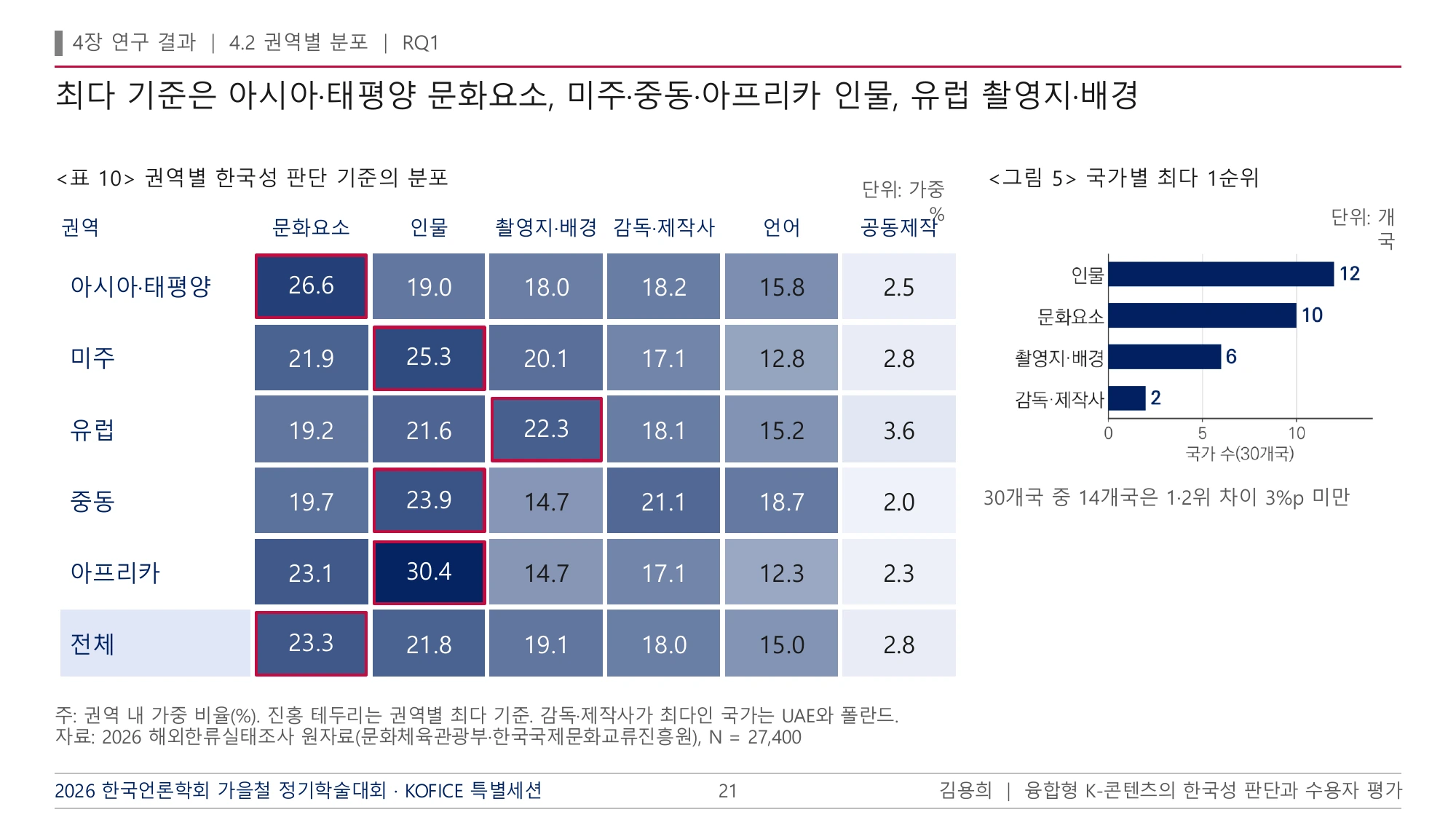
공동제작을 제외한 다섯 기준이 15.0~23.3%에 분산됐습니다. 아시아·태평양에서는 문화요소, 미주·중동·아프리카에서는 인물, 유럽에서는 촬영지·배경이 가장 많이 선택됐습니다. 다만 30개 국가·지역 중 14곳은 1·2위 차이가 3%p 미만이므로, 각 시장에 고정된 하나의 취향만 있다고 해석하기는 어렵습니다.
결과 2: 제작 주체 기준과 높은 수용 용이성의 관계
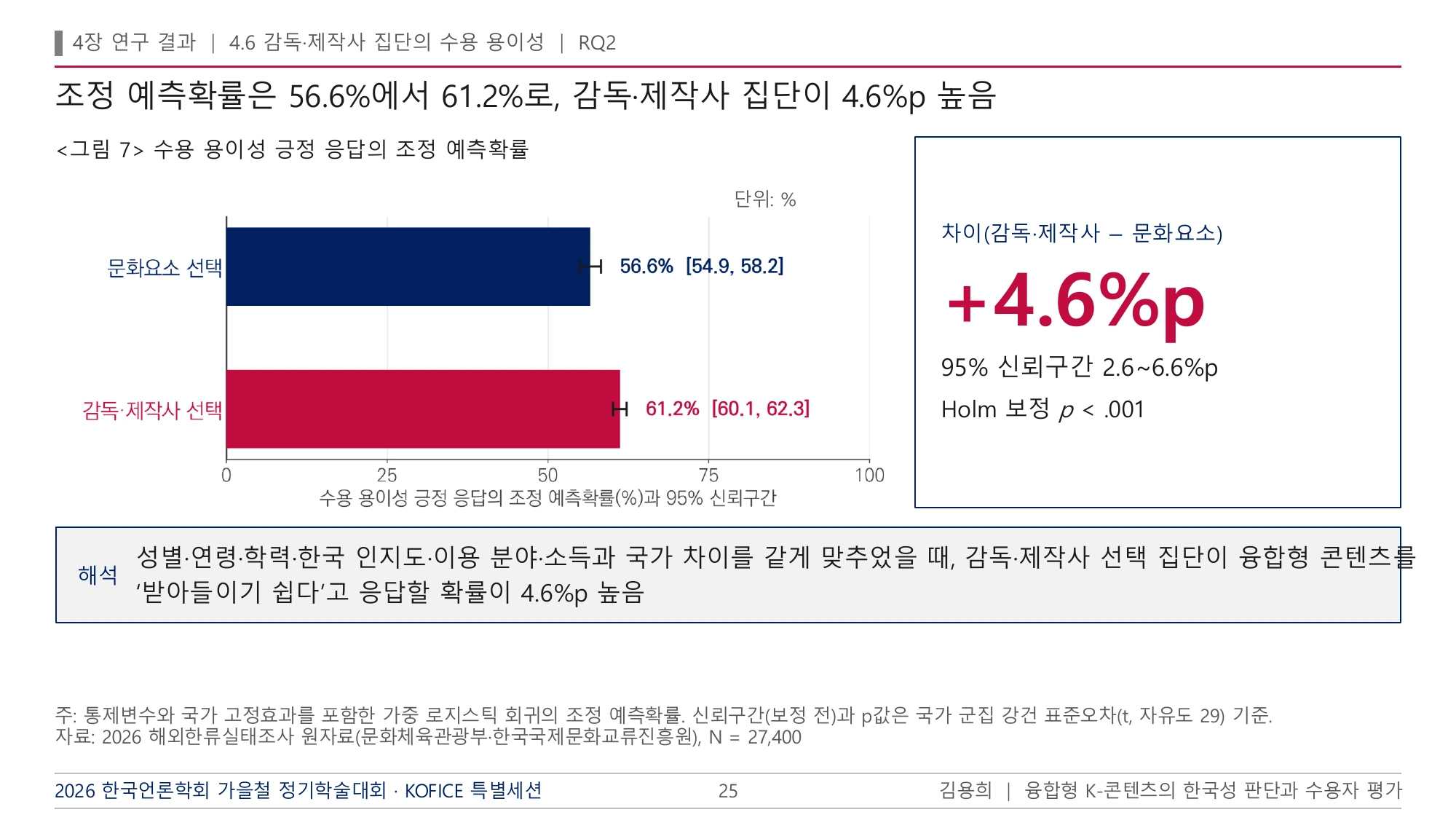
가장 일관된 결과는 감독·제작사 집단에서 나타났습니다. 개인 특성과 국가 차이를 조정했을 때 융합형 콘텐츠를 ‘받아들이기 쉽다’고 답할 예측확률은 다음과 같습니다.
| 판단 기준 집단 | 조정 예측확률 |
|---|---|
| 문화요소 | 56.6% |
| 감독·제작사 | 61.2% |
| 두 집단의 차이 | +4.6%p |
차이의 95% 신뢰구간은 2.6~6.6%p, Holm 보정 p값은 .001 미만이었습니다. 여기서 4.6은 퍼센트포인트 차이이며 상대적으로 4.6% 증가했다는 뜻이 아닙니다. 제작 주체도 융합형 콘텐츠를 한국 콘텐츠로 받아들이는 중요한 단서일 수 있다는 해석을 제시했습니다.
결과 3: 공동제작 집단의 낮은 평가는 어떻게 읽어야 하는가
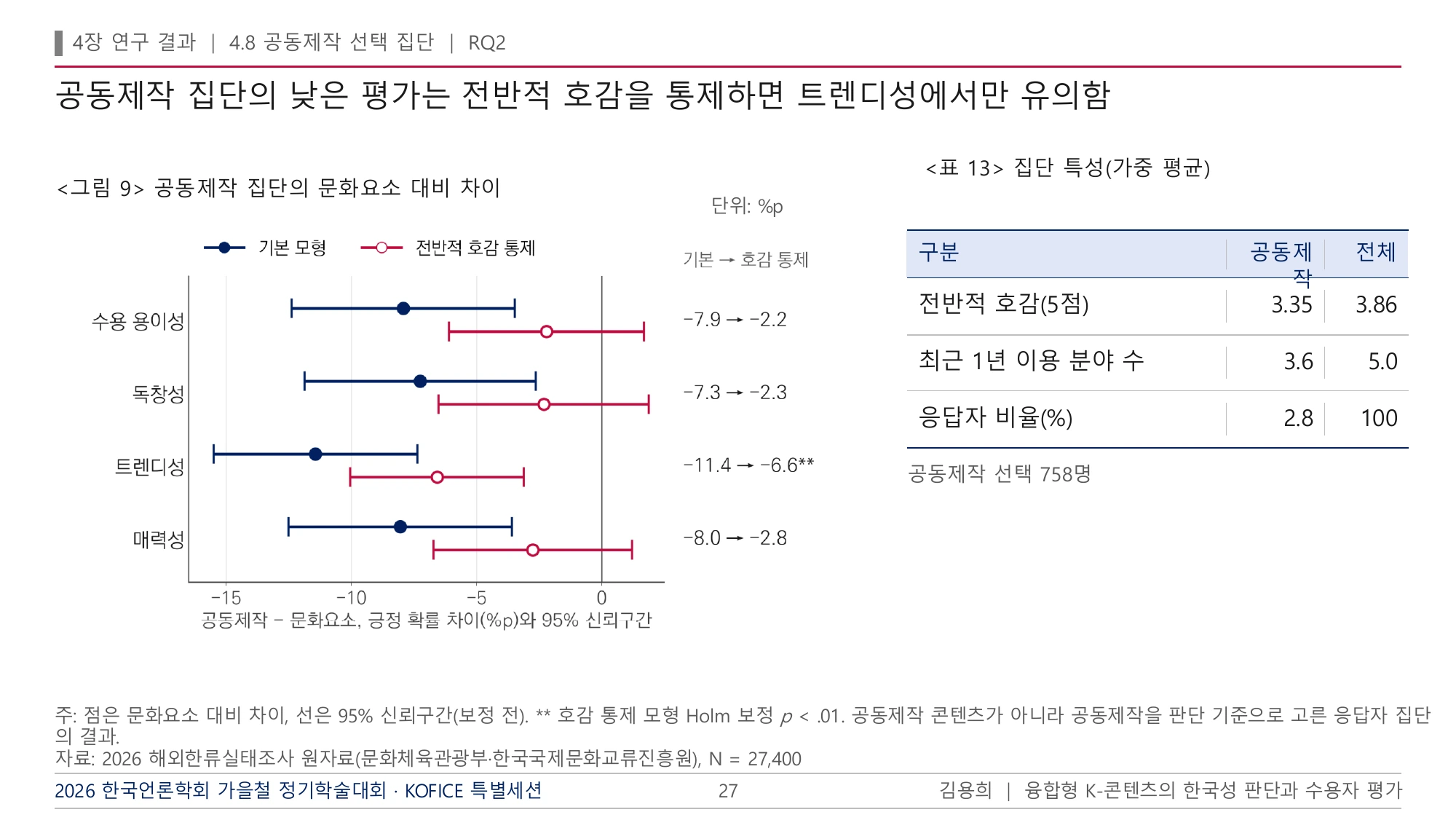
공동제작을 한국성의 1순위 기준으로 고른 집단은 전체의 2.8%, 758명이었습니다. 기본 모형에서 네 평가가 문화요소 집단보다 낮았지만, 한국 콘텐츠에 대한 전반적 호감을 함께 통제하면 트렌디성만 −6.6%p로 유의했고 나머지 세 평가는 유의하지 않았습니다.
이는 ‘공동제작 작품은 인기가 없다’는 결과와 다릅니다. 분석 단위는 작품이 아니라 공동제작을 판단 기준으로 선택한 응답자 집단입니다. 그 집단의 전반적 호감과 이용 경험이 낮다는 특성도 함께 고려해야 합니다(발표자료 27~28쪽).
강건성과 해석의 범위
감독·제작사 집단의 수용 용이성 차이는 전반적 호감 통제, 동일범주 응답자 제외, 무가중 추정, 선형확률모형, 서열 로지스틱 회귀, 국가별 추정치 통합의 여섯 점검에서 양의 관계로 유의했습니다. 한편 별도로 제시한 응답 패턴 통제는 지표 구성에 민감해 효과가 0에 가까워지는 결과도 있었습니다. 이 탐색적 결과를 제외하고 모든 분석이 같았다고 말해서는 안 됩니다.
독창성의 일부 차이도 비교 범위를 넓혀 다중비교를 보정하면 유의하지 않았습니다. 따라서 가장 안정적인 결론인 수용 용이성의 관계와, 조건에 따라 달라지는 다른 평가를 구분했습니다. 판단 기준은 관찰된 선택이므로 인과효과를 식별하지 못하며, 진정성이나 경계의 유연성도 직접 측정한 변수가 아닙니다.
NEXT 한류의 ‘K’를 논의할 때 남는 함의
한국성을 콘텐츠 안의 언어·인물·문화요소로만 좁혀 설명하기보다 누가 만들었는가라는 제작 주체의 관점을 함께 검토할 필요가 있습니다. 동시에 국가별 긍정 응답률을 곧바로 시장 수용도 순위로 해석하기보다 응답 방식과 표본의 성격을 살펴야 합니다.
후속 연구에서는 감독·제작사·자본의 국적을 분리해 묻고, 제작 주체 정보를 달리 제시하는 실험과 구체적인 작품 평가를 통해 이 관계를 더 정교하게 확인할 수 있습니다. 이 글은 학술대회 발표의 기록이며 학술지 게재 논문으로 표기하지 않았습니다.
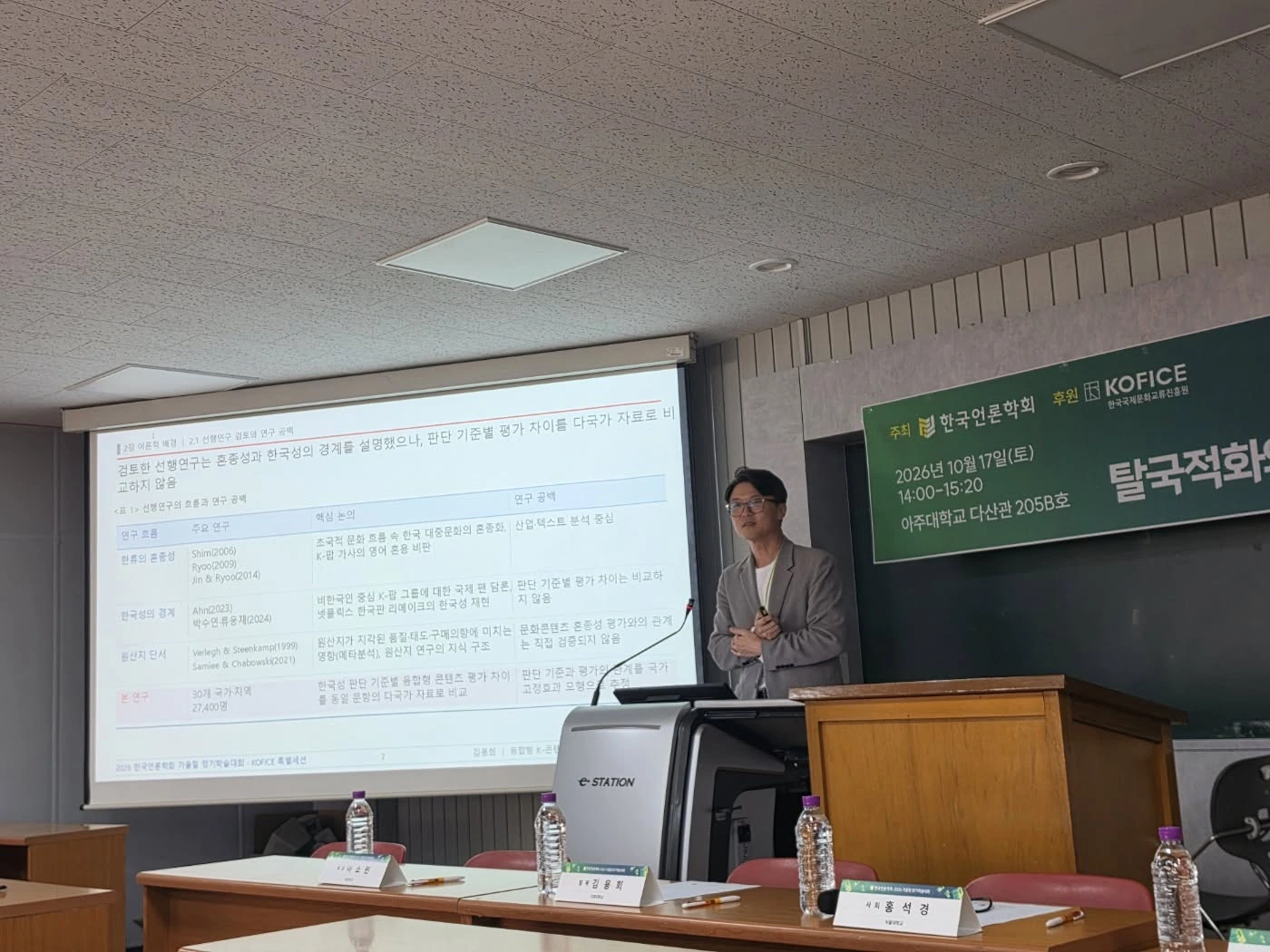
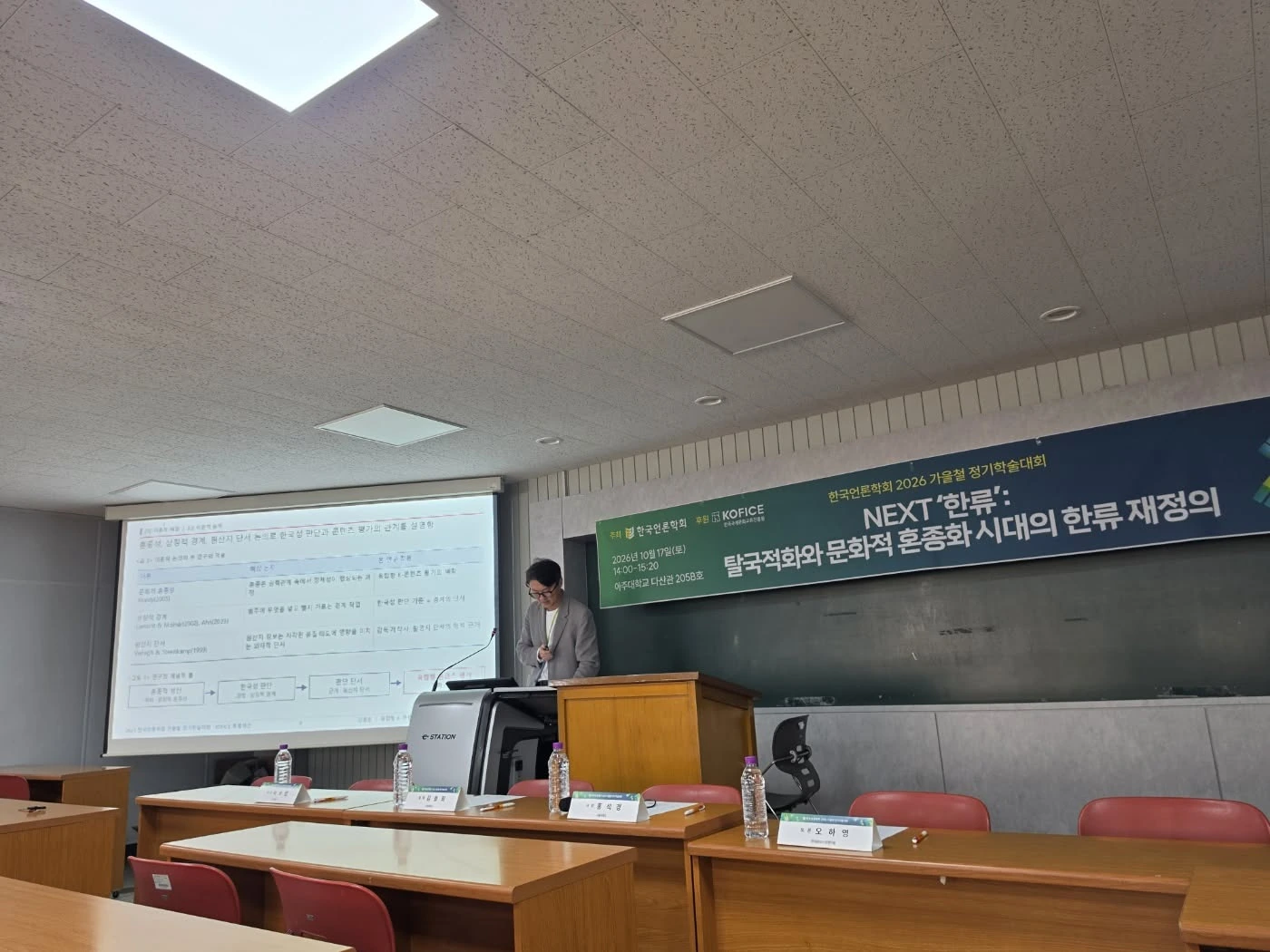
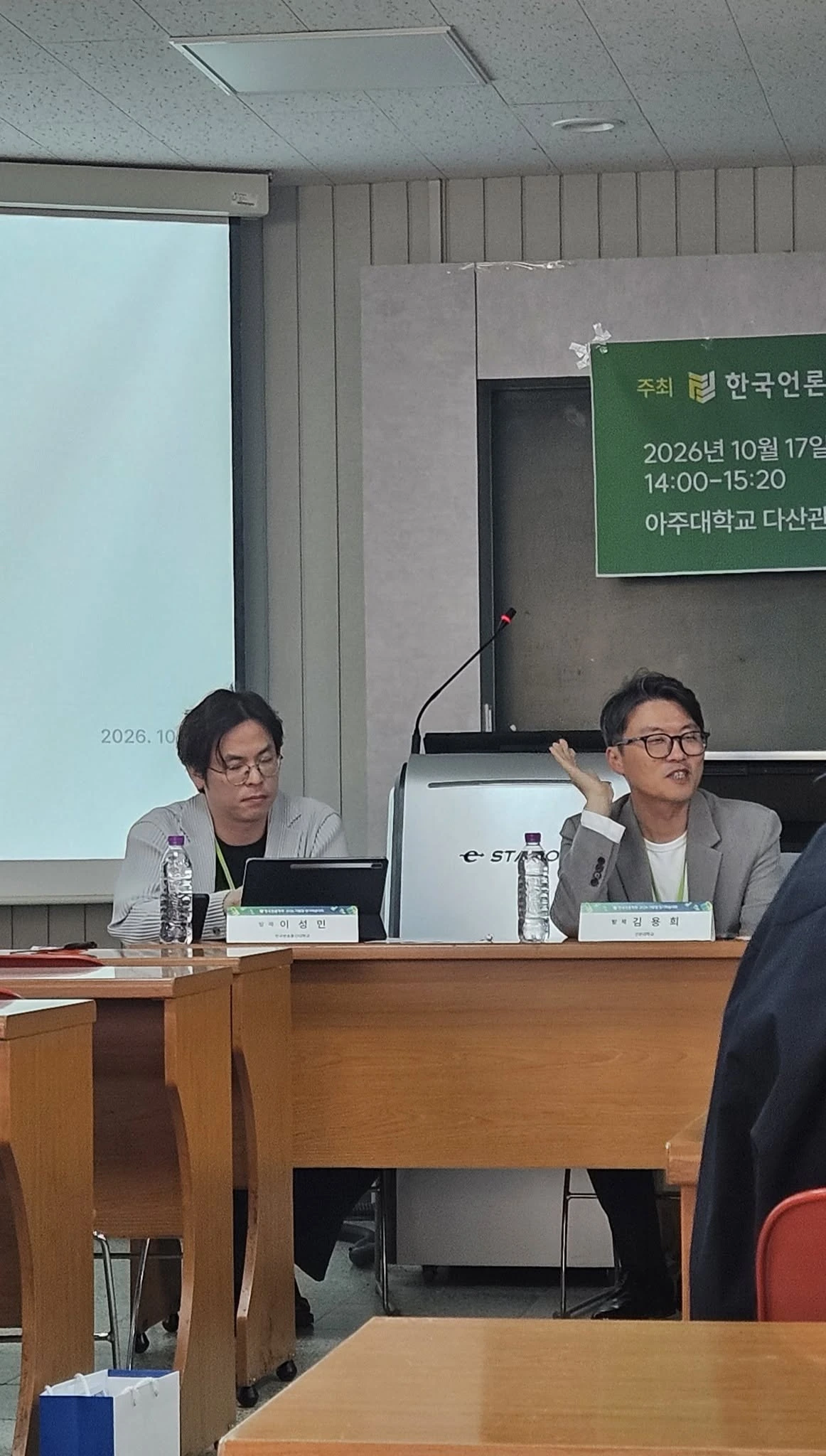
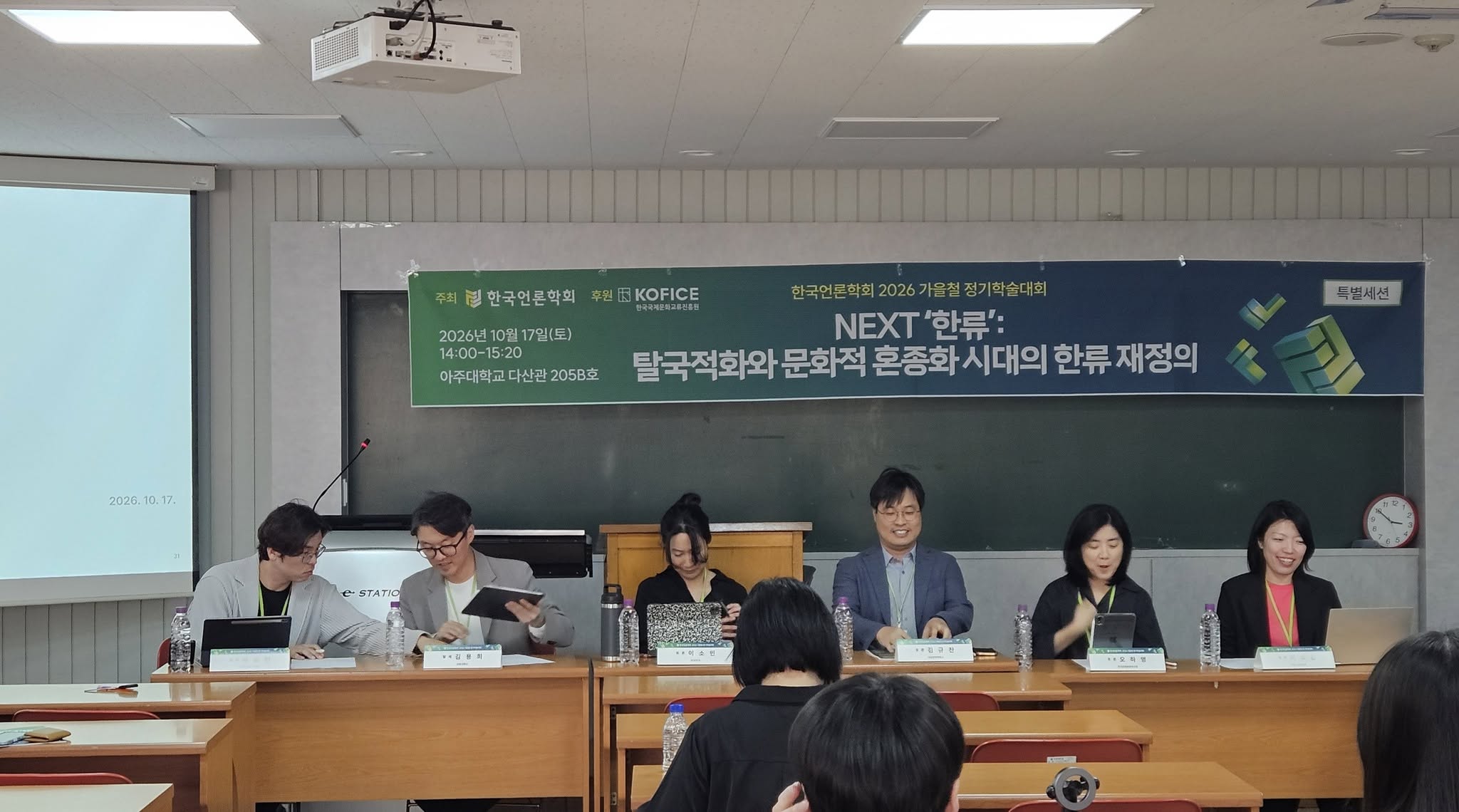
발표와 토론 현장 사진
자료 안내
수치·표·그래프는 당시 47쪽 발표자료의 13·20~28·30~33쪽을 중심으로 정리했습니다. 원자료를 새로 추정한 결과가 아니라 발표 결과를 설명한 기록입니다.
Perceived Koreanness starts with the audience’s classification
I presented “Perceived Koreanness and audience evaluations of hybrid K-content” in the KOFICE special session at Ajou University on 17 October 2026. The analysis asked which cues overseas audiences use to classify content as Korean, within a discussion of transnational production and cultural hybridity.
The central finding was a consistent association between selecting Korean directors/producers as the main criterion and greater perceived ease of accepting hybrid content. It does not establish a causal effect of production-origin information.
Data and design
The 2026 Overseas Hallyu Survey provided 27,400 respondents in 30 countries and regions, aged 15–59 and experienced with Korean cultural content. Online-panel fieldwork ran from 13 November to 12 December 2025. This is not a general-population sample.
The main Koreanness criterion had six categories. Four evaluations—acceptance, originality, trendiness and attractiveness—were modeled separately, with ratings of 4–5 on a five-point scale coded positive. Weighted logistic models included country fixed effects, personal characteristics, knowledge of Korea, content-use breadth and relative income. Country-clustered robust uncertainty and average marginal effects were reported (slides 12–18).
Finding 1: several competing criteria
| Main criterion | Overall weighted share |
|---|---|
| Korean cultural elements | 23.3% |
| Korean people | 21.8% |
| Korean filming location/setting | 19.1% |
| Korean directors/producers | 18.0% |
| Korean language | 15.0% |
| Co-production with another country | 2.8% |
Apart from co-production, the five criteria ranged from 15.0% to 23.3%. Regional leading criteria differed: cultural elements in Asia-Pacific, people in the Americas, Middle East and Africa, and location/setting in Europe. In 14 of the 30 countries and regions, the first two criteria differed by less than three percentage points, cautioning against a single fixed market preference.
Finding 2: production origin and acceptance
Adjusted probabilities of a positive acceptance response were:
| Criterion group | Adjusted probability |
|---|---|
| Cultural elements | 56.6% |
| Directors/producers | 61.2% |
| Difference | +4.6 percentage points |
The 95% interval for the difference was 2.6–6.6 points, with Holm-adjusted p < .001. This is an absolute percentage-point difference, not a 4.6% relative increase. The presentation interpreted production origin as a potentially important classification cue.
Finding 3: interpreting the co-production group
The 758 respondents selecting co-production represented 2.8% of the sample. Their evaluations were lower in the baseline model; after adjustment for general liking of Korean content, only trendiness remained significantly lower, by 6.6 percentage points. The other three differences were not significant.
The unit is a respondent group choosing that criterion, not a set of co-produced works. It therefore does not demonstrate that co-productions themselves are unpopular. Group differences in liking and experience matter (slides 27–28).
Robustness and limits
The directors/producers acceptance association remained positive and significant in six checks covering general liking, identical-category responses, weights, functional form, ordinal outcomes and country-specific pooling. A separate exploratory response-pattern adjustment was sensitive to indicator construction and sometimes moved the estimate close to zero. Not every specification gave the same answer.
Some originality differences also lost significance under broader multiple-comparison adjustment. The strongest result should be distinguished from more conditional findings. The design is observational, and perceived authenticity and boundary flexibility were not directly measured.
Implications for the “K” in Hallyu
Production origin deserves consideration alongside language, people and cultural elements within a work. Country-level positive-response rankings also require attention to response styles and sample composition. Future studies could separate directors, production companies and capital nationality, manipulate origin information experimentally and assess specific works.
This is a conference-presentation record, not a claim of journal publication.
Photographs from the presentation and discussion
Source material
The account follows the 47-page presentation, particularly slides 13, 20–28 and 30–33. It explains the presented estimates rather than reporting an independent reanalysis.